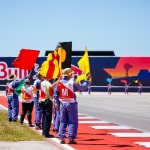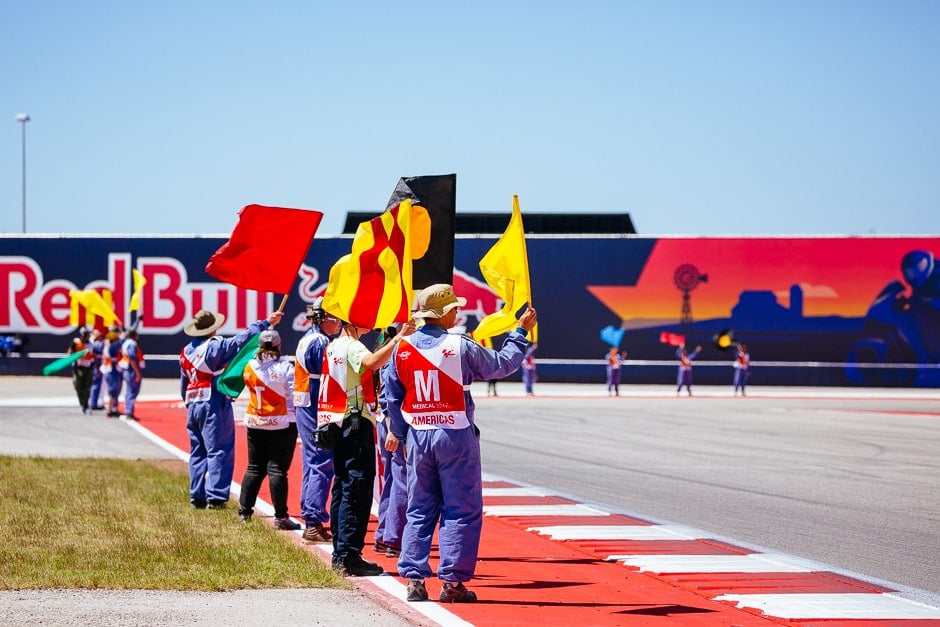
Track marshals at the end of the 2017 COTA MotoGP. Image courtesy Texas Highways
Updated 19 February 2026 to reflect changes for the 2026 season
Our grateful thanks to David Hawley (Chief Marshal MotoAmerica and Flag Chief at Austin MotoGP) for his assistance with this article.
Do you need to get up to speed with the safety warning systems, methods and penalties for rider infractions in a MotoGP event?
Let us help.
The following is an outline of how trackside marshals convey Race Direction’s instructions to riders, who often have only a split second to see and react to the information.
Because of the speed and risk involved, the best way to communicate with riders is through simple, instantly recognisable signals
To achieve this there are a small number of flags and lights that instantly tell a rider what is happening ahead and what action they are required to take.
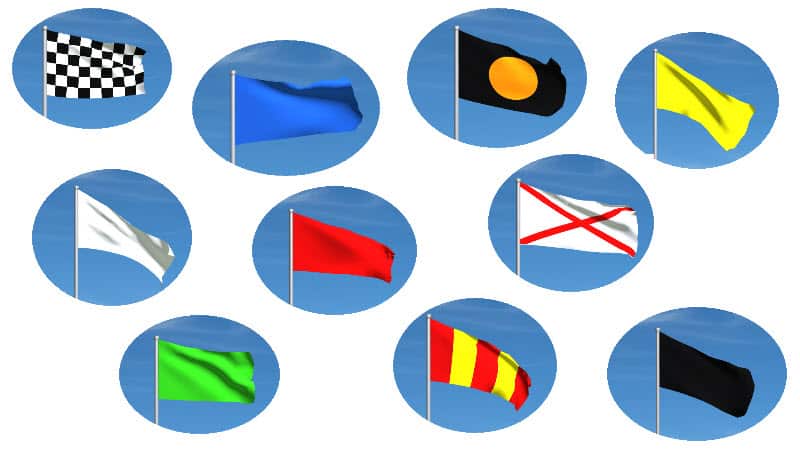
MotoGP uses both flags and light panels to communicate instructions to riders.
Light panels may be used in addition to, or instead of, flags (and can look slightly different due to technical constraints), but both flags and lights are official signals.
The use of light panels in association with waved flags is compulsory at all circuits.
A crucial difference is the flags can only be operated by the trackside marshal while the light panels can be operated by race direction or by the marshals trackside.
This means race direction can alert riders to issues not yet apparent to the marshals and vice versa when there is an issue visible to the marshal.
Even when you understand the rules and penalties, there are times when it seems Race Direction are simply making things up as they go and it can be confusing.
However, Race Direction has discretionary powers to decide re each incident as it occurs, considering the conditions and numerous other factors unique to each race before deciding if they issue a penalty and what that should be.
For the most part it is straightforward:
Flags
There are two kinds of flags used by trackside marshals in MotoGP.
The first kind are informative only and indicate to riders general information about the track and other issues regarding the race.
The second are instructional and will carry penalties to riders who fail to comply.
Note: the term marshal post is the placement of trackside marshals. It is important as some signals are to be given by every marshal post and others at only specific sections of the track.
Informative Flags
Green
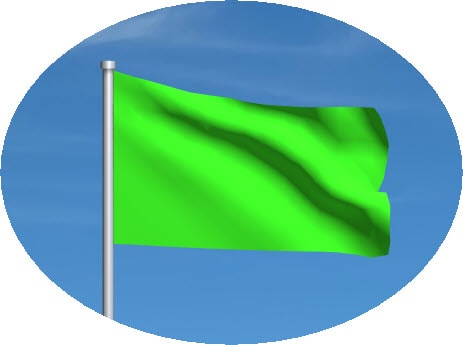
Tells the riders the track is clear and ready for use.
A green light is switched on at the pit lane exit to signal the start of each practice session and warm up, and the start of the sighting lap(s) and the warm up lap.
The green flag is seen at the pit lane exit to indicate it is now open and following any incident on the track that required a warning to be issued and is now resolved allowing for normal racing to resume. For example, after the clearing away of debris following a crash.
White with a Red 'X'

This flag indicates drops of rain on this section of the track, including rain affecting the track surface. It must be waved at the flag marshal post.
Red and Yellow Stripes
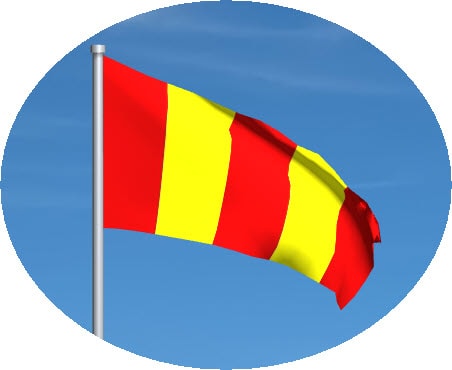
This is the surface flag and it means that the surface grip is affected by something other than rain (oil, gravel, grass or other debris). This flag must be shown waved at the flag marshal post.
Blue

A blue flag warns a rider that another rider is approaching to pass.
In practice sessions, the rider must avoid disturbing others by riding slowly off the racing line and allowing the faster rider to pass.
In a race, the blue flag means the rider is about to be lapped and must allow the lapping rider(s) through at the earliest opportunity — and passing within a group of lapped riders is forbidden under the blue flag.
A blue flag may also be shown at a marshal post after pit exit to warn a rider leaving the pit lane that riders are approaching on track.
Chequered

The chequered flag is used to indicate the end of the race as each rider crosses the finish line.
At the finish line, the chequered flag may be waved together with the blue flag when a rider closely precedes the leader on the final lap — the leader has finished, while the rider(s) ahead must complete the final lap and take the chequered flag.
Instructional Flags
The second set of flags are instructional and may carry harsh penalties if ignored.
The possible penalties available by race direction are as follows:
A Long Lap Penalty requires a rider to ride through a pre-defined route (usually on an asphalt run-off area) marked by white lines.
The rider must stay within the lines, rejoin safely, and overtaking is forbidden within the Long Lap route.
The penalty must be completed within the required lap window; if the rider does not comply within 3 laps of notification, they may be given a 2x Long Lap Penalty.
If a 2x Long Lap is imposed, both long laps must be completed within 5 laps of notification — otherwise the rider may receive a ride-through (or another penalty).
The Long Lap must not be carried out while yellow flags cover the penalty area; in that case, extra laps are added to the compliance window.
Yellow
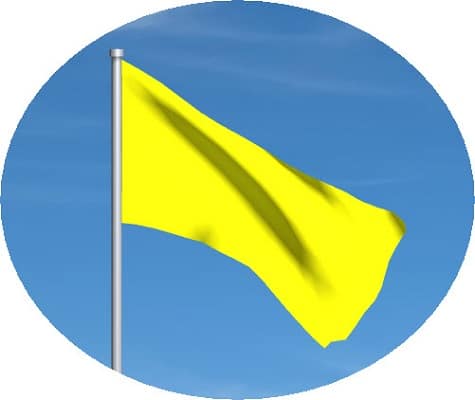
A yellow flag tells the riders several things depending on when and where it is used, also the number of flags can mean something different too.
If the riders see one yellow flag waved at every row while on the starting grid it will indicate the race is delayed.
If the flag is waved at a single row on the starting grid it indicates a rider on that row is having trouble.
Sometimes this results in the rider leaving the grid and starting from the pit lane once pit exit opens (after the delay specified for the circuit).
During the race if a single yellow flag is waved at a marshal post it indicates danger trackside ahead.
If two yellow flags are waved by a marshal post it tells the riders there is danger and an obstruction covers part or the whole of the track.
During a race, overtaking is forbidden from the yellow flag until the green flag is shown.
Any infringement will result in a penalty. However, if a rider immediately realises they’ve made a mistake, they should intentionally allow the overtaken rider(s) back through.
If the infraction occurs during practice/qualifying the lap time for that rider will be deleted and not counted towards qualifying.
Red
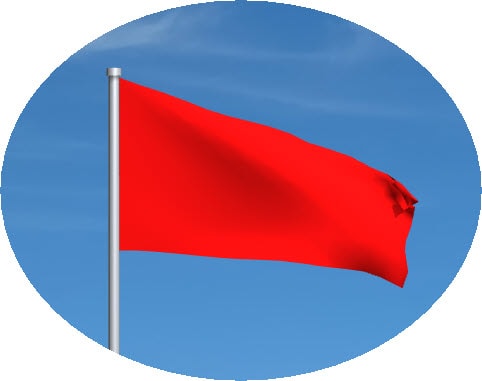
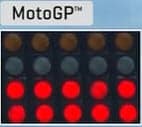
A red flag (with red lights around the circuit) means the session or race has been interrupted.
Riders must slow down immediately and return to the pit lane.
The red flag may also be used to close the track.
The red light at the pit-lane exit will remain on to let riders know they may not exit the pits.
When a race is stopped, results are taken from the last point where the leader completed a full lap without the red flag being displayed.
A partial classification is created for riders who crossed the line on the leader’s lap before the red flag, and another for riders who hadn’t — then these are combined to form the final classification using the lap/time procedure.
If a rider has entered pit lane and pit lane then closes due to the red flag, they may be classified using the virtual finish line time in pit lane (if they crossed it); otherwise their last finish-line crossing time is used.
Riders who are not actively competing when the red flag is displayed are not classified, and riders must enter pit lane within 5 minutes (crossing the designated pit entry timing point with their motorcycle) to be classified.
If this occurs and at least three quarters of the race has been completed by the race leader then the race will be deemed complete and full points will be awarded.
In the event this point has not been reached two options are available.
If fewer than 3 laps have been completed, the race is null and void and a completely new race will be run.
If it’s impossible to restart, the race is cancelled and does not count.
If 3 laps or more have been completed but less than three-quarters distance in MotoGP (two-thirds in Moto2/Moto3), the race will be restarted.
If a restart is impossible, the results will count and points are awarded as half points if less than 50% of the original distance has been completed, or full points if 50% or more has been completed.
If three-quarters distance in MotoGP (two-thirds in Moto2/Moto3) has been completed by the leader, the race may be deemed completed and full points are awarded.
This decision by race direction depends on the reasons for the interruption but history has shown if the reason is the death of a rider the race is over regardless of the amount of laps completed, all other scenarios are determined on a case by case basis.
You may also see the red flag held motionless on the grid at the end of the sighting lap (at the back of the grid) and at the end of the warm up lap (at the front of the grid).
Once the grid is set, a red light is displayed for between 2 and 5 seconds, then goes out to start the race.
White

A plain white flag, waved at the flag marshal post during the race, indicates that riders are allowed to change machine.
Only Race Direction can take this decision.
Separately, every race is categorised as wet or dry.
A board may be displayed on the grid to indicate the status; if no board is displayed, the race is automatically dry.
In MotoGP, the race is not interrupted for climatic reasons, and riders who wish to change machine (when allowed), tyres, or make adjustments must enter pit lane and do so during the race.
While the above instructional flags are used to communicate with the entire field the following two are directed at specific riders upon race directions say so.
Black
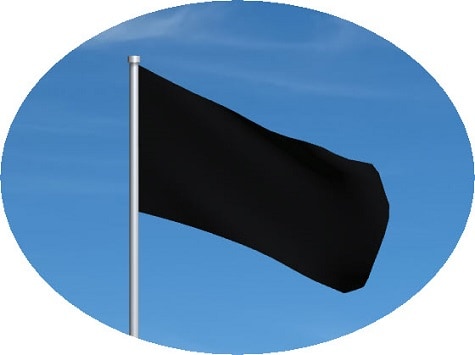
The black flag is waved at each flag marshal post together with the rider’s number.
When it results from a penalty, the rider must stop at the pits at the end of the current lap and cannot restart.
The black flag can also be shown for reasons other than a penalty (for example, to rectify a non-dangerous technical issue such as a transponder problem)
Black with Orange Circle

The black flag with an orange disc means the rider’s motorcycle has a mechanical problem likely to endanger themselves or others, and they must leave the track immediately.
The rider cannot rejoin unless authorised to do so by an official.
Considering the high speed and nature of racing there are plenty of opportunities for infractions of the rules, misunderstandings and accidents to test the safety procedures and keep race direction and marshals run off their feet.
It really is a well oiled machine deserving of great respect.