
Updated 19 February 2026 to reflect the changes for the 2026 season.
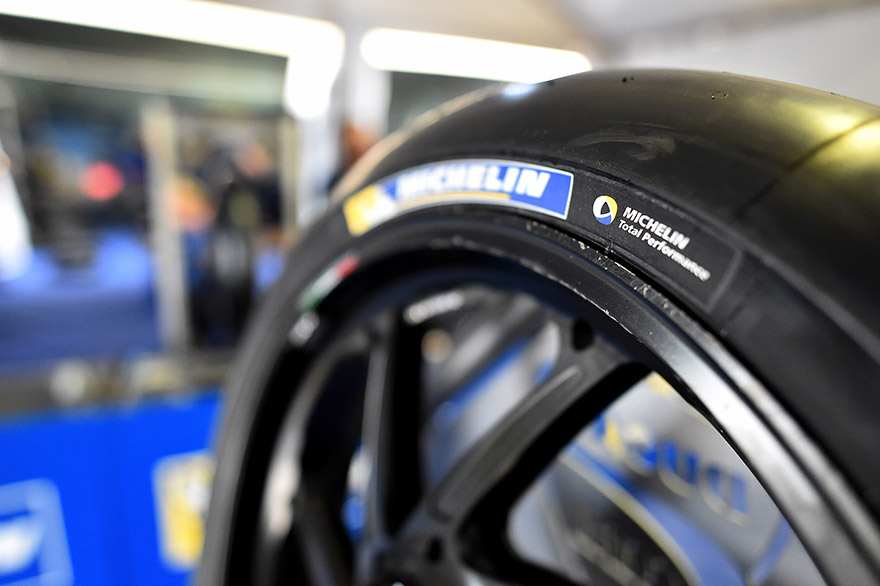
Michelin’s final season as MotoGP’s exclusive tyre supplier includes a notable tweak to front tyre allocation at most rounds (simplified to two options).
From 2027, Pirelli becomes the single tyre supplier for MotoGP, Moto2, Moto3 and MotoE, while Michelin moves to WorldSBK.
Michelin confirmed it will not introduce the planned new-generation front slick in 2026, meaning the current front tyre construction remains in use through Michelin’s final MotoGP season.
Quick Check: What’s changed for 2026?
The headline change is on the front: at most Grands Prix, Michelin has reduced the standard choice from three front specifications to two, but increased the number of tyres available per option—so riders can better understand and commit to their preferred front.
A small group of rounds keeps three front options due to higher weather/temperature variability.
Read on for the lowdown on MotoGP tyres.
You’ve decided MotoGP is the sport for you. You’ve watched a few races, you’ve picked a rider or two you like but now it’s time to take it to the next level and increase your knowledge.
So where to start? Qualifying, the points system or electronics? All good but you will come to see that, above all, a lot of time is spent on tyre choice.
It will be mentioned by the commentators on just about every issue. It can literally be a deal breaker.
For the most part, it seems a complicated thing to follow and the rules have changed a great deal in the last few years since Michelin took over supply at the end of 2015.
Michelin originally had the contract until 2023 but this was extended in September 2021 until 2026.
In a statement by Carmelo Ezpeleta, CEO of Dorna Sports, he expressed his satisfaction with Michelin's tyre provisions since their return in 2016:
“We’re very proud to continue our partnership with Michelin until at least 2026. Michelin has been a vital partner for MotoGP since it became the tyre supplier to the premier class in 2016, helping us to create one of the greatest eras of competition in motorcycle Grand Prix racing history. I’m delighted that we will reach a decade of collaboration and I hope we can continue building on this incredible foundation together. This agreement is fantastic news for all of us in the Championship."
I understand for a new fan, the discussion of tyre choices can seem like a foreign language. But it is actually quite simple if you know just a few key things.
So where to start? Let’s begin with the overall tyre itself in MotoGP.
Every rider is provided with harder tyres and softer tyres as well as tyres suitable for the wet and dry. The dry condition tyres are referred to as slicks.
What does that mean? Harder tyres are those that take longer to wear out but longer to warm up so better for longevity but won’t get you to the front in the first lap generally.
Softer tyres will get you to the front of the pack quicker but will run the risk of falling apart by the end of the race. If you are unskilled at finding this balance it can be the end of your chances for a podium that day.
Within these hard and soft options it is broken down again into symmetrical and asymmetrical or in some parts ‘Dual Compound’.
Symmetrical are the same ‘compound’ (remember this word for later) across the whole tyre. Asymmetrical (or dual compound) are a combination joined together in order to accommodate tracks with more left or right turns for example. This allows more wear on one side, the harder side.
Compounds are hard, medium or soft - for interest’s sake should you be close enough to see the tyres they do have a colour code:
What about in the wet though?
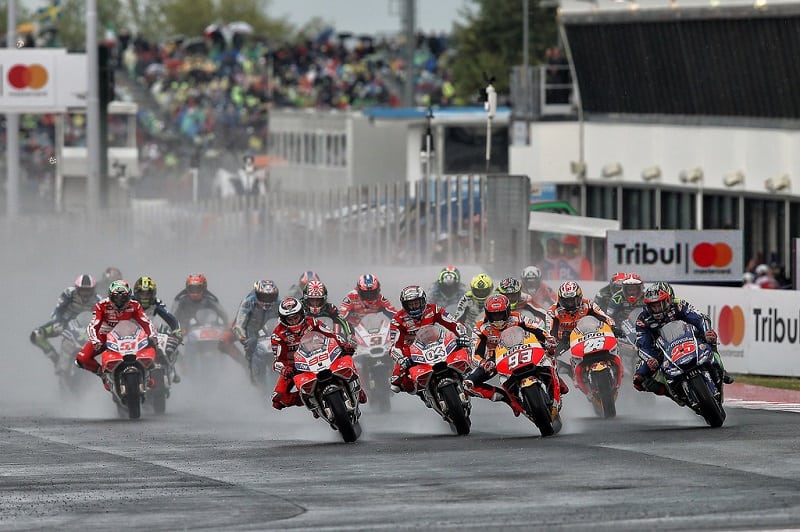
It works basically the same.
A selection of tyre compounds are developed to suit wet conditions, usually in a soft and medium option for the grip required in wet conditions.
Depending on the track in question they will be offered in both symmetrical and asymmetrical just the same as dry weather tyres.
Michelin did attempt to resolve the issue by developing an intermediate tyre for drying out or damp conditions which sounds great but for several reasons they have been scrapped as unnecessary.
So there is no intermediate tyre in MotoGP.
Instead, the two tyre compounds or spec choices are offered to counteract this issue.
So what can riders have for selection each race weekend?
Dry Weather Tyres
For the 2026 season, each MotoGP rider has a base allocation of 22 slick tyres per Grand Prix event:
10 front slicks and 12 rear slicks.
Front slick tyres (10 total)
(Specification A is the softer/higher-grip option; specification B is the harder option.)
The official tyre supplier will determine which specifications are suitable for each event.
* Depending on circuit/conditions, specification A may correspond to soft or medium, and specification B may correspond to medium or hard.
MotoGP tyres use a colour code for this:
In certain circuits, due to extreme track or weather conditions, a third front specification (C) may be provided:
Rear slick tyres (12 total)
Qualifying extra tyres
The two riders who participate in both Q1 and Q2 (i.e., progress from Q1 to Q2) receive:
If Q1 and Q2 are both declared wet, the extra tyres allocated will be rain tyres (preferred specification front and rear).
If Q1 and Q2 are declared as different weather conditions, then no extra tyre will be allocated.
Rain tyres
Standard allocation: 13 rain tyres per event:
If any 3 of the 5 sessions (FP1, Practice, FP2, one Qualifying session, and the Sprint — excluding warm-up) are declared wet, one more set (1 front + 1 rear) is allocated to every rider, and the total becomes:
Tyre Pressures
At the 2023 British MotoGP at Silverstone, Dorna first implemented yet another unification of electronics with the start of TPMS (tyre pressure monitoring systems) through a unified system.
Teams were no longer able to pick the device they like and are only allowed the unit provided by LDL Technology, who already supply MotoE.
Interestingly LDL beat out the brands that were already in use by MotoGP teams.
The TPMS (tyre pressure monitoring systems) records tyre pressure and temperatures in real time and reports it back for monitoring.
Riders are also able to see this on their dashboard warning/indicator and revise their riding to suit.
According to the rules the device must be connected and reporting data the entire time the wheel is on the bike.
It is also encrypted so teams cannot alter it.
Tyre Pressure Rules
Why you hear commentators talk about it so much!
MotoGP enforces minimum tyre pressures in the Sprint and Grand Prix races (not in every practice session), and the minimum can vary by circuit.
A lap is counted as “compliant” if the average of the pressure readings reaches the minimum.
For races over 15 laps, bikes must meet the minimum pressure for at least 60% of laps. In the Sprint, it’s 30%.
What happens if a rider doesn’t meet the minimum?
MotoGP uses set time penalties: 8 seconds in the Sprint and 16 seconds in the Grand Prix.
Why are tyre pressures important?
The lower the pressure the more grip and speed, up the pressure and the opposite occurs.
A good front tyre impacts corner speed entry and exit so really without good front tyre grip and longevity the rider really has no chance.
So why not lower it then if it gives more grip?
Well you then potentially weaken the wall of the tyre increasing the chance of an explosive blowout with possibly disastrous consequences.
Dorna's intention is to get on top of this with a unified system increasing safety and fairness.
Tyre temperature sensors
In addition to tyre pressures, tyre temperatures are also recorded.
This system can provide critical information to the riders about the performance of the bike including additional information about why a crash occurred.
For example, Jorge Martin's crash during the 2025 Sepang test was caused by a significant drop in tyre temperature.
It was first believed his tyre temperature was normal at the time of the crash when looking at data for the surface of the tyre.
However, surface tyre temperature varies depending on factors such as slide, spin of the bike and track temperature.
But there is a further sensor which detects the cavity air temperature and this is the temperature of the air inside the tyre.
Looking at the differences in the temperatures in this way a team can learn a lot about the performance of the tyres they have chosen and determine the cause of a crash.
In Jorge's case Michelin stated his tyre cavity air temperature was actually 15°C below the optimum/expected, leading to the cause of the accident being determined to be low tyre temperature.
Aprilia did dispute this.
Permitted tyre pressures
For the 2026 MotoGP season, the minimum mandated tyre pressures remain consistent with the standards established in 2024 and 2025 to ensure the structural integrity of the Michelin tyres.
Riders must maintain these minimum levels for a specific percentage of the race to avoid significant time penalties.
Riders must meet the minimum pressures for at least:
There are many factors at play with tyre pressure and it fluctuates for a variety of reasons, rider style also comes into play with some riders dealing with higher pressure better than others.
This will make it a highly complex issue for the teams to manage.
How do the teams go about making tyre selections?
All of these factors play a part in making the final tyre choice for race day. If a wrong choice is made or the tyres supplied do not withstand the conditions then a rider may eat through many more tyres trying to get it ‘right’ leaving a shortage of options if you like.
For 2018, Andrea Dovizioso at the Austrian GP and Marc Marquez at Valencia immediately come to mind.
Already one could feel a little stressed right!
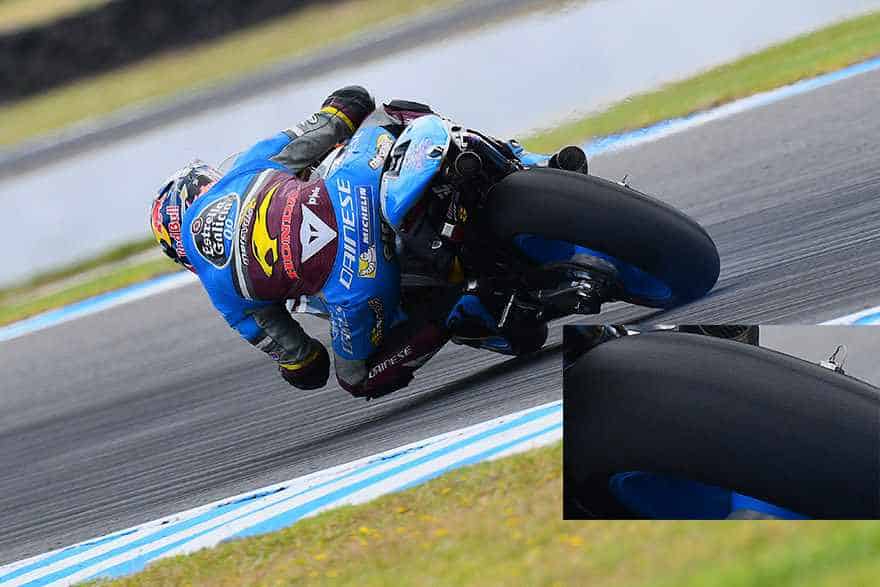
For example: COTA 2024
The circuit is bumpy. Why?
Because it's been built on clay soil which expands and contracts depending on the amount of water absorbed.
This means the track can change year on year.
A significant amount of the track has been resurfaced for this year's race in order to smooth out the bumps.
What is of particular note is Michelin's plans regarding tyres.
Piero Taramasso, manager of Michelin Two-Wheel competition has said:
“We know the COTA circuit very well, but we are bringing our new rubber compounds this year, which creates some unknowns.
On the other hand, we know that the grip will be low, and that its surface will be uneven in places.
Based on our data and taking into account the configuration of the circuit, we selected symmetrical tyres for the front, in three compounds (Soft, Medium, Hard) and two asymmetrical options for the rear, in Soft and Medium.
The right shoulder of the rear tyres will be harder, but this is not to compensate for the number of turns, but rather for the sequence of the triple right-handers (turns 16, 17 and 18) which generates very high stresses on the tyres.
We intend to provide the perfect technical package to our partners, who broke numerous records on this track last year and who of course intend to try to do better this year, partly thanks to our tyres.”
This is an historical example to show the thinking process.
In Summary
Now to make you feel better…minus the extra rules for events like storms that require a special decision from race direction, that’s pretty much it. That’s tyre allocation and selection under the new rules.
To make you feel even better - we now only have one class in MotoGP. Prior to 2016 there was the open class –that’s been done away with so now there is only one set of rules to learn and they don’t impact tyres outside of testing anymore,
This does not mean everyone is just lumped together regardless of financial position of the factory. There is simply a less complicated way of dealing with the concessions made. But we won’t go into this here.
The only other issue is how does one tell what tyres a rider is using without a commentator to tell you?
Not to worry FIM have got that sorted. Fans now have the benefit of electronic documenting of tyre selection – the information will be displayed on screen for viewers.
Give it a go next time you are watching a race to follow along with the discussions on tyre selection and its effect on the outcome.
Understanding this element of MotoGP adds an extra level to watching the race. Not to mention you’ll be able to impress your MotoGP loving friends with your new knowledge on tyre selection!



Love all things motorcycle, especially technical! Keep it comin.
Ended more confused than I was in the beginning. Definitely not for beginners!
GREAT TIRE INFORMATION , ARE THERE GOING TO BE MORE CHANGES IN 2021 SEASON ??
Thanks 🙂 Just updated the article. No changes for 2021.
Just updated the article for 2021 following some rule changes 🙂