Updated 19 February 2026 to incorporate the changes for the 2026 season.
2025 saw Brembo celebrate 50 years in motor racing.
“We are proud to celebrate this racing anniversary,” said Matteo Tiraboschi, executive chairman of Brembo Group. “Thanks to 50 years of top-level experience, today all Formula 1 and MotoGP teams choose Brembo. The data collected by our engineers shows that the winner is often not the one who goes fastest, but the one who brakes best.”
Brembo has proven its commitment to innovation and safety over the past 50 years in motorsport and this year is no different. With the recent changes to aerodynamics helping MotoGP teams get even more speed out of the bikes it means Brembo must keep producing a braking system that can tolerate the intense heat and pressure applied.
For the 2026 season, MotoGP teams continue to use carbon front brake systems, with riders able to choose between different Brembo specifications depending on riding style and circuit demands. (Brembo also introduced a newer caliper specification for 2025 alongside the GP4 design released in 2020.)
In a statement released by Brembo it explained the 2025 version included optimised contact pressure, with an oversized pad capable of withstanding extremely high temperatures.
This ensured constant and powerful braking even in the most critical situations.
This also permitted riders to manage the bike with extreme precision and promoted rapid heat dissipation which has improved pad wear and consistency over the race.
They also made it even easier for mechanics to provide the required maintenance and brake bleeding.
Now onto all the detail about brakes in MotoGP.
With a possible top speed of over 360 km/h (record 366.1 km/h) your brakes are probably pretty important to you.
Not to worry.
With Italian company Brembo onboard since 1976 they’ve got our boys in leather covered.
So let’s take a look at what makes Brembo’s brakes capable of being MotoGP’s stopping power of choice across the entire grid.
What are they made from?
For those new to this technical stuff there are four main components to the braking system:
Discs

Pads
Calipers
Since the release of the GP4 caliper in 2020, riders have switched to this option.
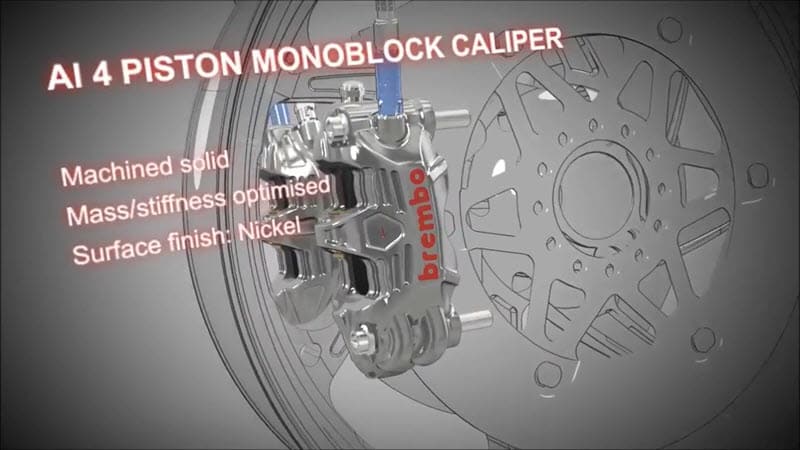
The GP4 is a monobloc aluminium caliper machined from a solid piece of aluminium and features a radial attachment and four pistons.
What is the difference?
The GP4 is a monobloc aluminium, 4-piston radial-mount caliper. It uses an amplification system that can increase braking torque for the same lever force.
When the rider is not braking, the GP4’s anti-drag system helps prevent the pads from remaining in contact with the disc (reducing “residual torque”).
The external fins help dissipate heat from an area under high thermal stress.
and Master Cylinder
Brembo manufactures both the discs and the pads from carbon which can provide some serious stopping power and consistency throughout an entire race.
Recent statistics show these brakes allow a MotoGP bike to go from 300kph to under 100 in about 5 seconds using only 300m of track.
This does equate to less durability with carbon brakes only lasting about 1000 kms.
Before the use of carbon, the discs were steel and the pads an organic material.
There are several differences when using the carbon discs and pads over the traditional steel including weight, temperature issues and durability.
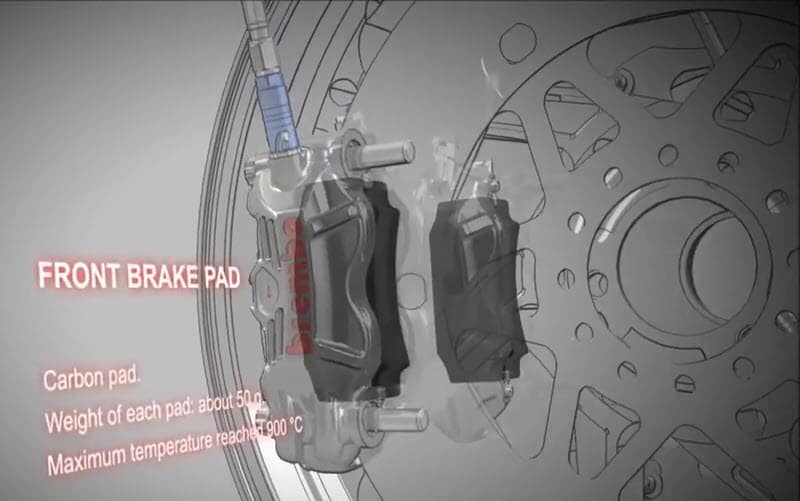
For example, carbon pads weigh just 50gm each (2 per caliper) compared to the organic material brake pads which weigh 125gm each.
Brembo’s braking systems also include the master cylinder and calipers. The calipers are machined from a block of aluminium providing consistency in structure and performance.
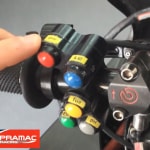
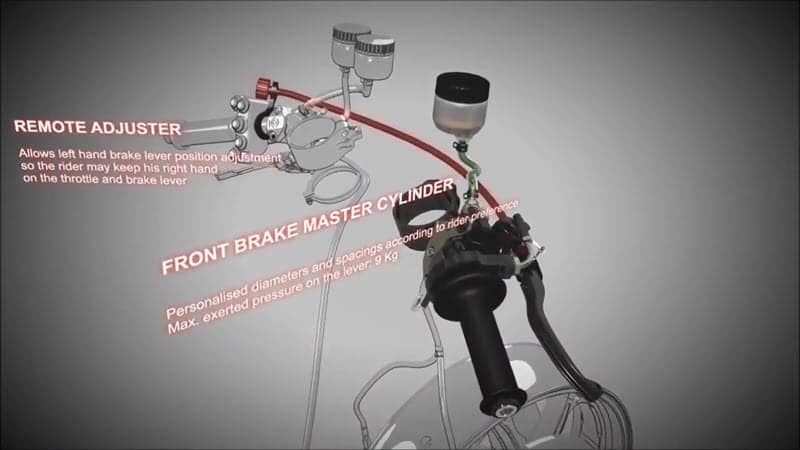
Levers allow the rider to apply brakes but also allow them to make some adjustments as they are riding.
Brembo also provide the popular thumb master cylinder system.
What is a thumb master cylinder system?
This basically makes it possible for the rider to use the rear brake with their thumb via a small lever on the left handlebar.
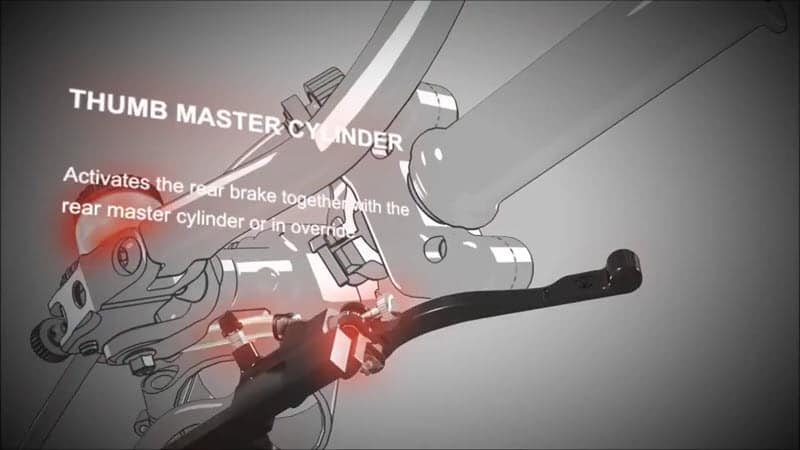
This was originally developed in the 90s to assist Mick Doohan following a serious injury to his right leg which saw him unable to operate the brake lever with his right foot.
It has been used over the years by other riders following injury including Rossi in 2017.
Many riders use it as a type of traction control in certain braking conditions and it has proven beneficial for riders with larger feet during right hand turns to operate the brake with the lever instead.
It also adds another variation available to the braking system to suit each rider’s personal preferences such as Dovizioso described prior to his retirement.
“The force you can apply with your finger on the thumb master cylinder is a great deal less than what you can apply with your foot. That is why I only use it when the bike is at the maximum lean angle.”
He goes on to explain it is most useful to him when leaning right.
Other riders use this braking option to avoid losing grip when cornering so it really does add to the personalisation of braking for the riders.
Temperature issues
There are differences in handling carbon brakes over the steel version when it comes to temperature. Carbon brakes need to heat up to the correct temp for optimal braking functions and consistency for the rider.
Once at their ideal temperature, between 250C and 850C, they are second to none in terms of performance – remembering above how quickly these types of brakes can stop these powerful machines.
Where a track puts a higher demand on the brakes and temperatures across the discs exceed this it can lead to deterioration of the brakes’ performance.
Enter what is called a higher mass disc (340mm rather than 320mm) providing more surface area for the pads to make contact giving more durability on high demand tracks.
So if temperature is a factor what happens in cold or wet conditions?
There was a time it was an automatic return to steel discs and organic pads.
However, in 2017 Marquez won in Misano, Italy using carbon discs in the rain and dramatically changed the established view that riders should automatically switch to steel discs in the wet.
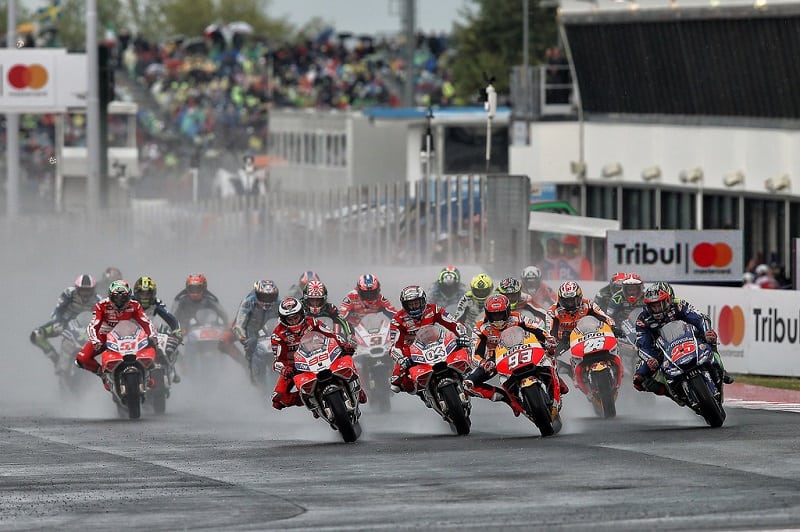
Just a few months later and we saw Dovizioso become the second rider to win and the first nine riders cross the finish line in Motegi, Japan using the carbon brakes in a very wet race.
Dovizioso proved it was no fluke when he won again in Valencia 2018 in the wet with carbon brakes.
It seems with the progression of technology and development from the Brembo team it is now possible to keep to the high-performance carbon brakes in the wet.
What happens on high demand tracks?
On high-demand tracks, riders typically move from 320 mm discs to 340 mm or 355 mm options to increase braking torque and heat capacity.
Brembo also offers Standard vs High Mass versions: “High Mass” refers to a larger braking surface (helping manage heat and consistency), not a thicker disc.
Brembo notes MotoGP carbon discs are 8 mm thick regardless of diameter, with different material/cooling specifications depending on circuit demands.
According to the rules of the FIM (Fédération Internationale de Motocyclisme), certain tracks have a mandatory requirement for safety reasons, that the use of 340 or 355mm carbon brake discs are used when a Dry race is declared by Race Direction.
At Motegi (Japan), Spielberg (Austria) and Buriram (Thailand) the use of 340 mm or 355 mm is mandatory for both the Sprint and Grand Prix race if the race is declared Dry by Race Direction.
There are no restrictions on disc sizes in a race declared Wet.
Rider Choices
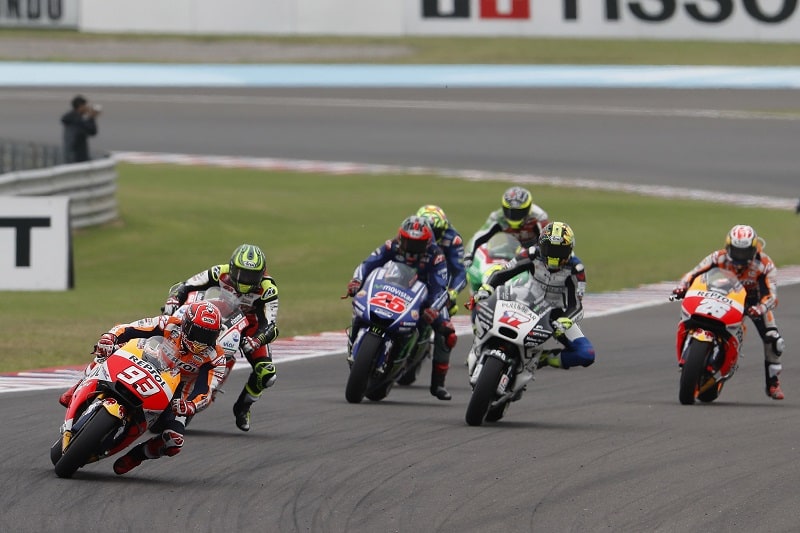
Like with tyre options, riders can set up their brakes to suit their own braking style and the demands of each circuit.
In MotoGP, front carbon disc outside diameters are 320 mm, 340 mm and 355 mm, and suppliers provide multiple variants across those sizes (different disc geometries and material/cooling specifications such as Standard, High Mass, and ventilated/finned options).
This gives teams multiple “feel” and temperature-management choices without changing the permitted diameters.
What is the advantage of the ventilated option?
The precision-controlled ventilation (internal channels) helps the disc cool by improving air circulation through the disc’s cooling chamber.
This can improve consistency and reduce pad wear on circuits that are especially demanding on brakes.
Note: this is separate from the FIM mandatory disc-size list — some circuits are “tough on brakes” in practice, but only the circuits listed (as mentioned earlier) in the regulations require 340/355 mm in Dry races.
Brembo is dedicated to working with the riders to develop ways to make the braking system as responsive to the rider’s style as possible and being able to customise certain elements is evidence of this dedication they have shown for decades.
Not only is the rider counting on the brakes themselves, they are relying on the levers and brake lines to carry the messages correctly giving consistency and accuracy each and every time they pull that brake lever.
This is a very difficult demand for Brembo to deliver since the engagement point changes with the temperature of the brakes and, as Andrea Dovizioso pointed out before his retirement, he liked to have almost no play in his lever before the brakes engage and may adjust this up to eight times a lap to maintain consistency in his braking technique.
So, what do brakes like these cost?
MotoGP teams purchase what is called a front brake “MotoGP Season Package”.
For MotoGP, this package is capped at €80,000 per rider (excluding VAT and freight) and is intended to cover the basic minimum dry-weather front wheel braking needs for one rider for one season.
The package is supplied as either:
Option 1
Option 2
Where regulations mandate certain disc sizes at specific circuits, at least one set of each mandated size (plus sufficient pads) must be included. Teams can buy extra quantities during the season, but only from the supplier’s approved parts list.
Relevant rules
Brake disc carriers may be made only from aluminium and magnesium alloys.
Composites (including carbon fibre reinforced, glass fibre reinforced, and similar) are not permitted.
There is no ABS.
ABS or Anti-Locking Braking systems are designed to prevent wheel lock up during braking and therefore maintaining contact or traction with the track surface.
When we let it sink in that these bikes do not have this feature it really is outstanding that they manage to complete a race at all!
FIM are very clear about this point in the rule book that the only input is from the rider manually.
There are allowances for them to have levers etc configured to suit the riders' preferences and can use the brakes from the available options as they like.
Riders get no electronic assistance that controls brake pressure (e.g., ABS), but the ECU does manage strategies like traction control, anti-wheelie and engine-braking management
The IMU system is an inertial measurement unit and tells the bike what it is doing such as the pitch, yaw and acceleration.
It takes in data and measurements, sends the results to the ECU (electronic control unit) which uses this information to help operate functions like braking control from the rider's input, acceleration launch control and helps control wheelies
So, while they can use the rear brake at certain times to provide a sort of traction control it is quite astonishingly the skill of the rider and the set up of the braking system that allows for this.
An example of such braking skills is outlined in this statement given by Andrea Dovizioso leading up to the French Grand prix in 2018:
“If the rear [tyre] starts to lift then you have to ease pressure on the brake; this is bad. You have to try and brake hard and strong and if you have to let-off then you’ll lose a metre. You have to push your weight to the rear of the bike as much as you can: if you use all your muscle strength you can stabilise the bike and brake to the maximum.”
So that’s it.
The basics on Brembo’s MotoGP braking systems and how they provide the stopping power for some of the fastest machines on the planet.
Now you can impress your fellow fans with your understanding of carbon braking systems in MotoGP.