Updated 6 February 2026 to reflect the changes for the respective 2026 seasons.
Many consider MotoGP the pinnacle of motorcycle racing and it is the premier class.
It brings fans the best of the best in racing on two wheels.
But it is not the only championship with high-speed action and talented riders racing on international circuits.
In this article we will look at World Superbikes (also known as WSBK) and the differences to MotoGP.
Surprisingly, there are a number of similarities but also some significant differences.
How different are the seasons?
The MotoGP season is considerably longer, almost double in fact.
MotoGP runs a longer season in 2026: 22 rounds, opening in Thailand (27 Feb–1 Mar 2026) and finishing in Valencia (20–22 Nov 2026).
WorldSBK runs 12 rounds in 2026, starting with the Australian Round (20–22 Feb 2026) and finishing with the Spanish Round (16–18 Oct 2026).
Are there any differences in the circuits where the races take place?
Both still race internationally, even using the same circuits in some locations such as Assen, Aragon, Balaton Park, Catalunya, Phillip Island and Portimao.
In Britain the WSBK use Donington Park while MotoGP use Silverstone like F1.
WorldSBK has much more of a European flavour with only Phillip Island in Australia the exception.
Does World Superbikes match MotoGP in terms of motorcycle specifications and technology?
The Bikes
The bikes themselves are the biggest difference between the two.
MotoGP bikes are not anything the everyday person can purchase and ride around.
They are prototypes purposely built for top level racing and are not road legal in any way.
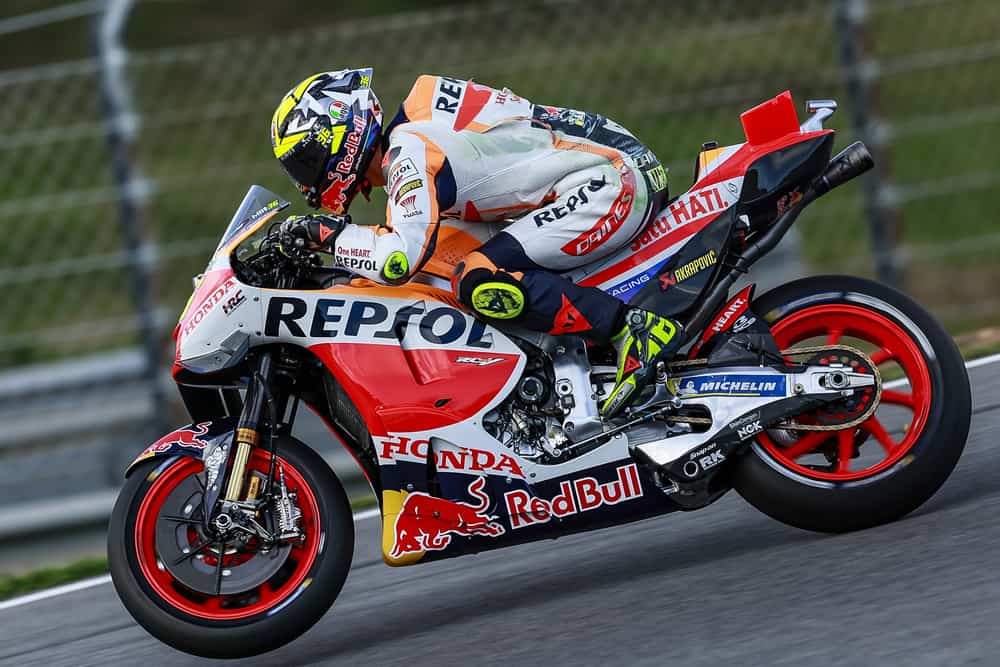
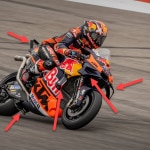
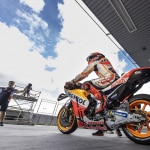
Joan Mir MotoGP Image courtesy of Box Repsol on Flickr
Superbikes are, however, built so that fans can relate them to their road bikes and are referred to as production-based bikes built for racing.
Superbikes are far more restricted in how they can tune the bikes compared to MotoGP.
These factors as well as costs are what make WSBK more accessible for teams to enter as opposed to MotoGP.
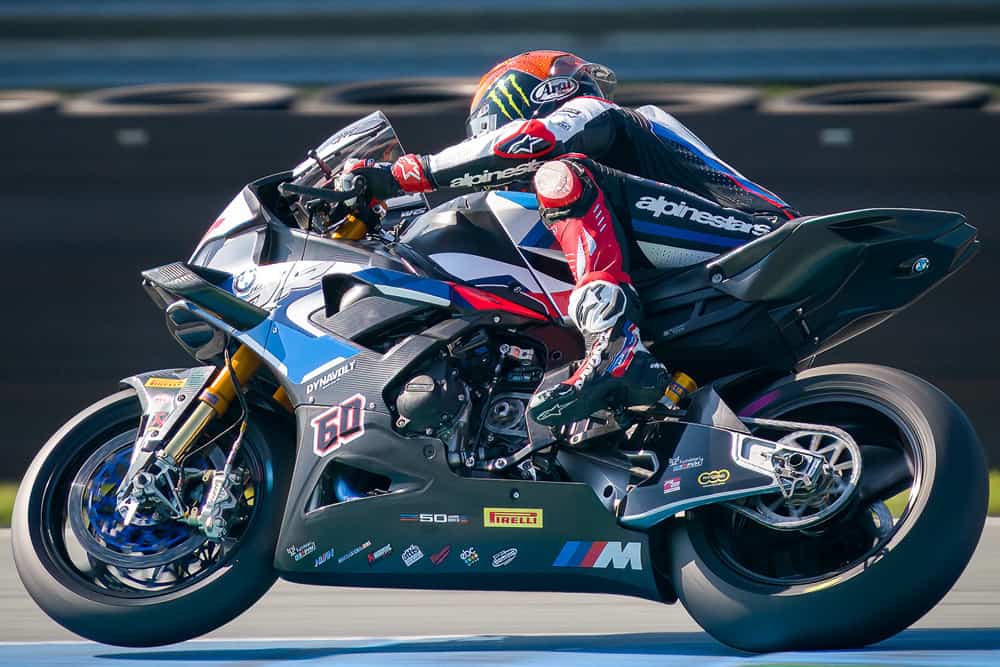
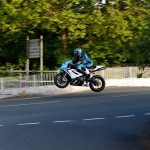
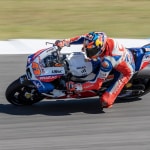
Michael Van Der Mark WSBK Image courtesy of Hasan Karagülmez on Flickr
Due to this, basically every aspect of a MotoGP bike is vastly different.
Materials on MotoGP bikes include the likes of titanium and Inconel.
Cost is often not a factor so every part of the bike is manufactured at the highest level available.
Let's have a closer look at the differences.
Electronics
MotoGP uses a single control ECU and software platform across the grid, which reduces how much a team can “buy” advantage purely through bespoke electronics.
WorldSBK typically allows more flexibility in electronics (within approved systems), and because the bikes start life as road models, some approaches feel closer to high-end road-bike development.
Aerodynamics
MotoGP has led the charge with aggressive aerodynamics, and it’s common to see large aero packages evolving through a season.
WorldSBK does have aerodynamics too, but the production-based baseline and regulations usually keep solutions closer to the road-bike silhouette, with less “prototype freedom” overall.
Engines
MotoGP is strictly 4 stroke 1000cc engines, that is the only bike capacity allowed in MotoGP.
This will change for the 2027 season with a move to 850cc engines.
Whereas in WSBK there are options and the regulations state as follows is allowed for Superbike Class
- Over 750cc up to 1000cc 4 stroke 3- and 4-cylinder
- Over 850cc up to 1200cc 4 stroke 2-cylinder
Article 2.4.2.1 of the WSBK regulations (page 88) further allows for concessions and allowances to be made for equity between machines.
More on this later in this article.
So there is a lot more variety in Superbikes than MotoGP.
Tyres
Essentially tyre selection works the same across the two championships.
Each has a supplier they must use, teams cannot select their own tyre manufacturer.
Both have a set tyre allocation for wet and dry as well as a selection of compounds to choose from.
Let's have a look at how each one works.
MotoGP:
Supplier Michelin
Dry Weather Tyres
For the 2026 season, each MotoGP rider has a base allocation of 22 slick tyres per Grand Prix event:
10 front slicks and 12 rear slicks.
Front slick tyres (10 total)
(Specification A is the softer/higher-grip option; specification B is the harder option.)
The official tyre supplier will determine which specifications are suitable for each event.
* Depending on circuit/conditions, specification A may correspond to soft or medium, and specification B may correspond to medium or hard.
MotoGP tyres use a colour code for this:
In certain circuits, due to extreme track or weather conditions, a third front specification (C) may be provided:
Rear slick tyres (12 total)
Qualifying extra tyres
The two riders who participate in both Q1 and Q2 (i.e., progress from Q1 to Q2) receive:
If Q1 and Q2 are both declared wet, the extra tyres allocated will be rain tyres (preferred specification front and rear).
If Q1 and Q2 are declared as different weather conditions, then no extra tyre will be allocated.
Rain tyres
Standard allocation: 13 rain tyres per event:
If any 3 of the 5 sessions (FP1, Practice, FP2, one Qualifying session, and the Sprint — excluding warm-up) are declared wet, one more set (1 front + 1 rear) is allocated to every rider, and the total becomes:
The World Superbike Championship:
Supplier: Pirelli
The number available to each rider during the event will be 21 (10 Front and 11 Rear tyres). Two sets of wet weather tyres will be made available at every round.
Pirelli makes the following compounds for riders to choose:
3 rear tyre compounds –
2 front tyre compounds –
For each event, the allowance per rider (maximum use of tyres per rider) is 10 front and 11 rear
Both championships now have minimum tyre pressure rules. MotoGP regulates this by using a highly advanced, automated system for real-time monitoring.
WorldSBK relies more on grid-based manual checks and team-specific data rather than a series-wide live automated system.
Exhausts
MotoGP is able to choose their exhaust supplier. However, the majority of the field choose Akrapovic.
The same applies in Superbikes, the teams can select their own exhaust provider and names such as Akrapovic and SC-Project feature on both grids.
Lots more information about MotoGP exhausts is available in our article here.
Which is the fastest?
MotoGP is faster.
To give you an example.
At the 2023 Misano MotoGP, the fastest lap time was 1:31.791 by Francesco Bagnaia with a top speed of 303.3 Km/h (188.46 mph) by Dani Pedrosa.
At the 2023 Misano Superbike meeting, the fastest lap time was 1:33.901 (Alvaro Bautista) with a top speed of 278.4 kmh (173.0 mph) also by Bautista.
You must remember that MotoGP bikes are custom built with advanced electronics and the very latest lightweight materials with seemingly no expense spared. Superbikes are essentially standard production machines, finely tuned with some modified parts.
What about the Governing Bodies and Penalties?
Governing Bodies
FIM is the governing federation; Dorna is the commercial rights holder/promoter (both series operate under FIM championships, with Race Direction/Stewards applying sporting regs)
Penalties
Penalties are one area where the two are almost a carbon copy with both utilising the following options for penalties imposed:
The penalties are:
The reasons for penalties being imposed are also nearly identical in both sports with both technical, racing and behavioural penalties being available.
The bodies which oversee the imposition of penalties are the stewards panel, the appeal panel and the court of appeal for both and their appeals processes are also the same.
More detailed information about MotoGP infringements and penalties is available in our article here.
Which championship attracts more manufacturers and teams?
WSBK and MotoGP share many of the same manufacturers, with a few additional ones like BMW and Kawasaki.
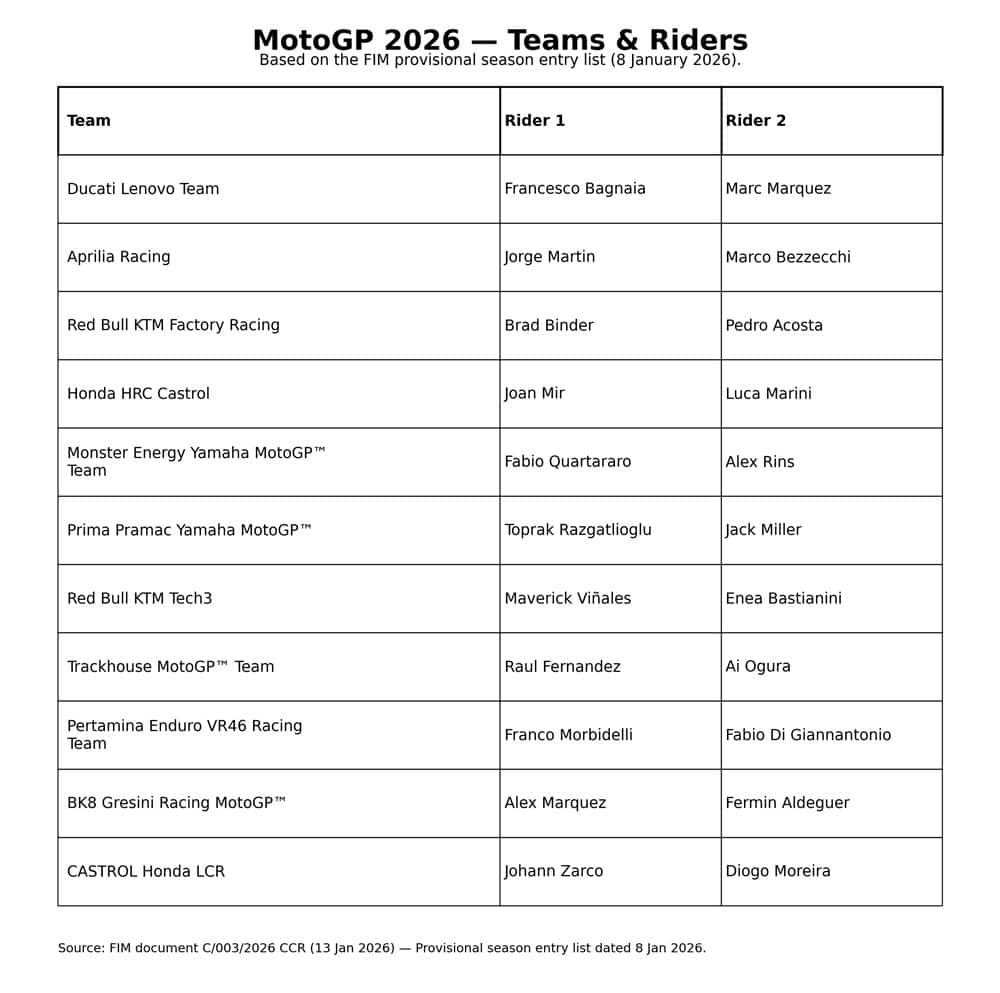
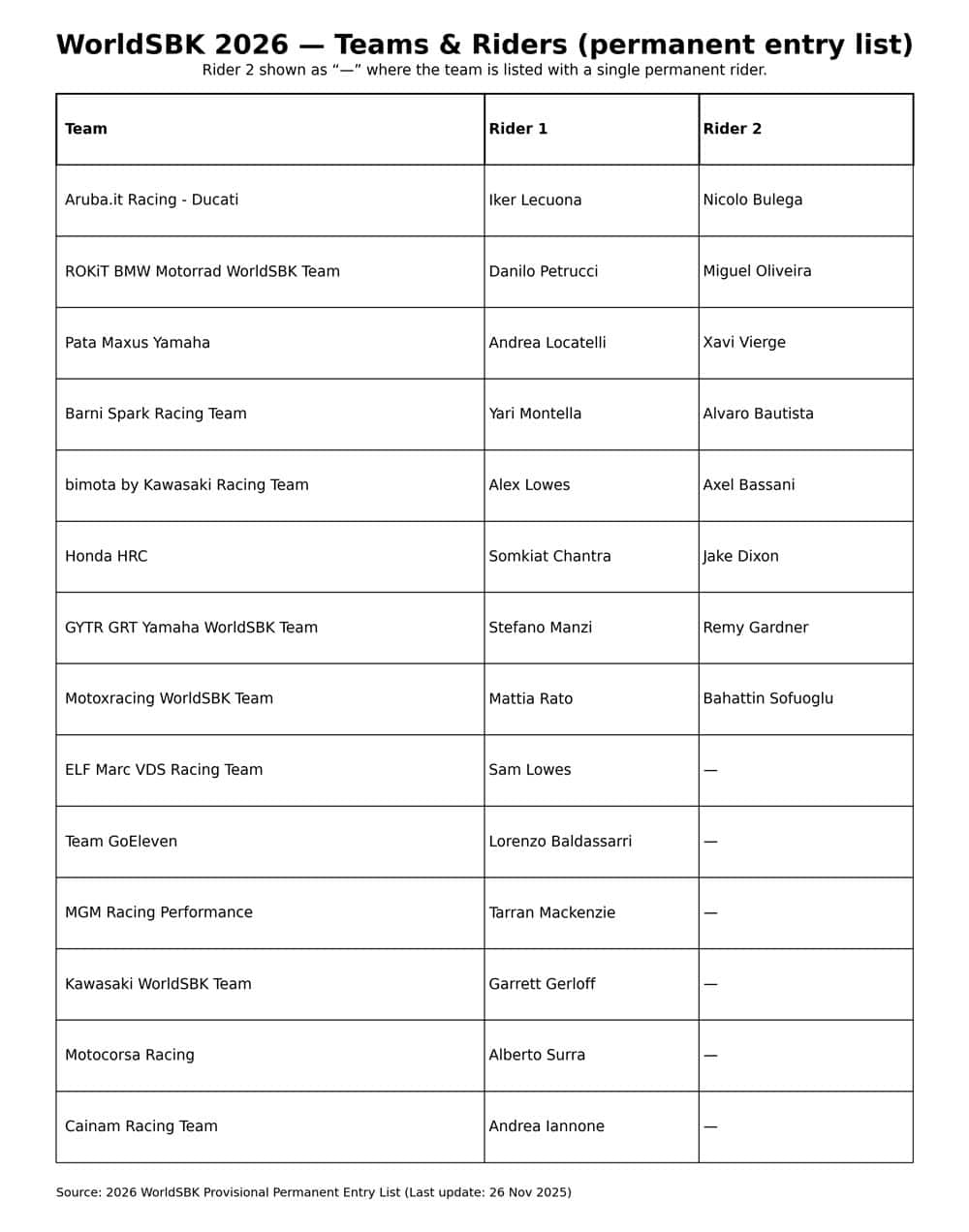
In 2026 there are 14 teams in WorldSBK and 11 in MotoGP.
The official grid line ups for 2026:
MOTOGP
World Superbikes
How about Budget?
One other main difference between the two is team budget, with MotoGP having seemingly unlimited funds especially for the factory teams, Superbikes do not enjoy this luxury even for factory teams.
Are there any variations in the age and experience of the riders in the two championships?
It was thought riders from MotoGP crossed over to WSBK towards the end of their career as it was easier, with less power and less pressure on you to perform at that elite level.
And while it may be a step out of the spotlight it is still racing at an elite level.
2025 MotoGP rider Miguel Oliveira made way for three-time Superbike champion Toprak Razgatlıoğlu for the 2026 season and Oliveira now races in the 2026 WorldSBK Championship.
2025 MotoGP rider Somkiat Chantra also moved to WorldSBK for 2026 from MotoGP being replaced by the 2025 Moto2 champion Diogo Moreira.
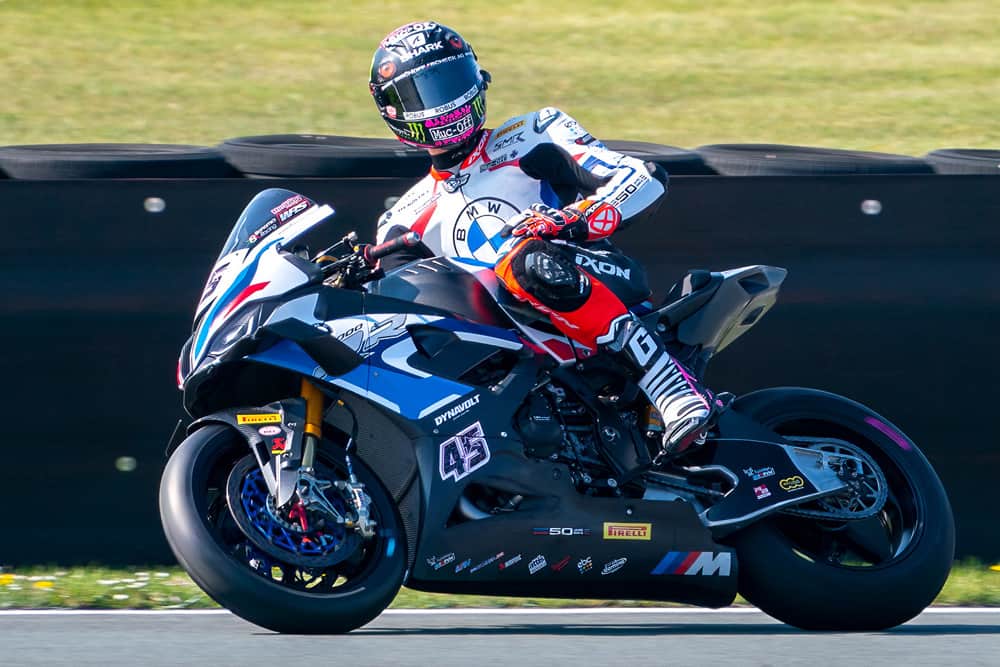
Scott Redding WSBK Image courtesy of Hasan Karagülmez on Flickr
Are the rider ages similar?
Both Superbikes and MotoGP have age limits of 18 to begin racing.
Both codes also have a maximum age of 50 for MotoGP class and Superbike class.
Do the championship classes differ?
The two championships essentially work the same with two feeder classes into the main class or as MotoGP call it Premier class.
In MotoGP the classes are as follows
Superbike classes have a little more variety within them and are as follows
While many believe Superbikes is less power and capacity this is not the case. The limitations on speed and power come from the imposed restrictions on the engines.
What are the major differences in terms of race formats between the two championships?
Superbikes
The format is:
Friday
Saturday
Sunday
The results of the Superpole race decide the first 9 positions on the grid for Race 2 and the rest from 10th onwards will be decided by their qualifying times (Superpole results).
Race 1 and 2 are full length races with full points on offer 25 points for a win down to one point for 15th.
Thus, Superbikes has three opportunities each race weekend to score championship points.
MotoGP
Friday
Saturday
Sunday
How does the WSBK look to make the racing competitive?
In WorldSBK (Superbike) for 2026, performance balancing is handled primarily through a fuel-flow limit rather than rev caps.
The FIM technical roadmap sets a 2026 reference fuel-flow value of 46.0 kg/h, and manufacturers start the season with manufacturer-specific maximum peak limits (under reference ambient conditions).
Fuel-flow control is enforced in Superpole and the races (not practice), and there is no maximum rev limit in the Superbike class.
A fuel consumption tolerance of 0.5 g per lap applies, and exceeding it can be penalised at the discretion of the FIM SBK Technical Director.
The starting “maximum peak” limits by manufacturer (2026):
- Bimota: 46.0 kg/h
- BMW: 45.0 kg/h
- Ducati: 45.0 kg/h
- Honda: 46.5 kg/h
- Kawasaki: 46.0 kg/h
- Yamaha: 46.5 kg/h
You will see that BMW and Ducati start lower than the other manufacturers which is because of their superior performance in 2025 and there is a "carry over" from the 2025 adjustments,
Adjustments can be made during the season at Concession Checkpoints, which occur every two rounds of the championship
How do the concession points in MotoGP and WSBK compare?
MotoGP concession points
Following approval by the Grand Prix Commission ahead of the Valencia GP 2023 a major change to concession points in MotoGP was rolled out and now mean teams will be divided into 4 ranks – A, B, C or D depending on Constructor Points awarded.
The rankings will be determined on the percentage of the possible maximum points they have accrued in each window.
The two windows are as follows:
Window 1: From the first event to the last event of the season.
Window 2: From the first event after the summer test ban to the last event before the summer test ban begins in the following season.
Manufacturers will be ranked based on the percentage of points scored in the Constructors championship. The regulation states this as follows:
That is, points scored divided by the maximum points awarded (25 x the number of GP Races held, plus 12 x the number of Sprints held)
Not only have they changed how the concessions are worked out it will have an impact on things like the number of tyres allocated at testing, aerodynamic updates, engine approval processes, and whether they have access to Wild Card Riders.
WSBK concessions are certainly more complex than MotoGP in order to deal with the variations allowed in WSBK.
Where can you see the racing on TV?
Broadcast and streaming rights change by country and can change year to year so it's best to check for your location.