Updated 23 February 2026 to reflect the rule changes for the 2026 season.
Updated 1 March 2026 to comment on the Marquez/Acosta incident and penalty in the Thai Grand Prix Sprint.
Infringements and penalties in MotoGP are not all neatly outlined somewhere and they are certainly not black and white.
However, infringements and the penalties imposed are an important aspect of the sport and understanding them brings another dynamic as a spectator.
The regulations and penalties outlined in the 401 page FIM GRAND PRIX WORLD CHAMPIONSHIP REGULATIONS (in the documents section) do not just apply to riders.
It applies to all "riders, teams’ personnel, officials and promoters/organisers, and all persons involved in any capacity whatsoever in the event or in the Championship."
Regulations are broken down into a couple of categories: technical regulations and behaviour or riding regulations.
So, there are rules for engine capacity, the number of engines, electronics, exhaust regulations and so on.
Then there are regulations regarding behaviour on and off the track.
A hot topic of contention is always penalties issued and the fairness of the decisions.
Especially those decisions that are not based on "Judge of Fact" (more on judge of fact later in this article) but rather discretionary calls by stewards.
So let’s take a closer look at penalties and infringements in MotoGP.
Penalties can be given for many reasons and are often a source of much banter among riders and fans who agree or disagree with decisions of the stewards as we are prone to do in any sport.
In some cases, they have taken away the human error factor in assessing if a penalty is needed with the introduction of track limit sensors in recent years.
The most recent addition being the tyre pressure monitoring systems now compulsory and unified.
Speeding in pit lane is another penalty issued that has no discretionary factors at play,
The penalty depends on the session; in-race it’s typically two long-laps.
There is a hierarchy of protest and appeal options for riders but they must act fast as some time limits for a protest or appeal can be as short as 1 hour.
Some options to appeal certain offences have been removed with the implementation of the judge of fact.
More on this further down where we look at the appeals process.
First let’s have a look at the different penalties handed out and some of the reasons riders find themselves penalised and sometimes even their pit crew.
The possible penalties are as follows:
In what circumstances do we see these penalties applied?
Warnings:
Warnings from race direction or stewards can be made privately or publicly and can be made without a hearing.
We will often hear them talk about a track limit warning, meaning the rider has exceeded the track limits more than the rules permit – this warning is displayed on their dash in text (TRKLIMIT) and only race direction can remove it completely, teams can override it if there is an engine problem that needs to be displayed.
Fines:
A cash penalty of up to 100,000 Euros but only up to €5,000 without a prior hearing.
In Valencia in 2022 Marco Bezzecchi was issued a fine following a spectacular crash in which his Ducati caught fire.
He was then seen making physical contact with a marshal trackside in what was considered an aggressive and unprofessional manner.
He was subsequently fined 1,000 Euros and given an official warning.
This is also an example of the ability for the rider to be hit with more than one penalty for the same incident as per art. 3.2.2 which covers plurality of penalties.
There is a right to appeal a fine.
Change of position:
A rider must go back the number of positions decided by the FIM MotoGP Stewards Panel.
This is during the race.
There are times when a rider gains an advantage that is unfair and is required to forfeit the gained positions.
This was immediately brought into play in the Sprint at the first race weekend of the 2026 season at the Thai Grand Prix.
On the penultimate lap with Marc Marquez in a thrilling multi-lap duel with Pedor Acosta, Marquez went for what I would describe as a "late lunge" to get past his rival.
Was there contact?
Acosta was forced well off the racing line into the run-off losing the lead.
The stewards intervened and Marquez was forced to drop one position thus losing the win.
With Simon Crafar now in charge one can but hope for consistency so at least the riders know where they stand but there will always be different opinions about such incidents.
Could it be that Simon Crafar is setting the tone for the 2026 season? We shall see how things pan out in due course.
The official body of Stewards are there to oversee the safety of the event as well as infringements.
It’s a tough job most of us will probably never understand and often disagree with their decisions!
In addition, exceeding the track boundary on the last lap which would normally mean a long lap penalty (see below), but clearly cannot do so, can result in losing a place.
Brad Binder fell foul of this at Assen 2023 when in third place at turn 8. He was demoted to 4th promoting Aleix Espargaro to the podium.
Incredibly the same thing happened to him in the sprint race on Saturday exactly the same corner (turn 8) on the last lap.
Brad crossed the finish line in third and was demoted to 5th giving Fabio Quartararo 3rd place.
Long Lap Penalty(ies):
What is a Long Lap Penalty?
The rules state:
A rider must complete the pre-defined route of the Long Lap applicable both to an infraction during practice sessions, which is carried over to the race, or to an infraction committed during a race and which is worthy of an immediate penalty, or which can be applied in the following race.
At every Championship circuit, a corner is designated to have an additional longer route marked at the edge of the track, which a rider who has received the corresponding penalty has to take. The Race Direction tell the penalised rider that they have to take the longer route with the consequent loss of time.
Long Lap Penalties are often given for crossing the boundaries of the track
In 2021, the penalty system for drifting off the track was modified and sensors were installed to detect when a rider strayed off the track limits.
Prior to this it was up to the FIM stewards to determine whether or not they had exceeded the track limits.
Removing human error from this has saved a lot of protests over decisions.
This is also not a decision you can appeal.
When is the Long Lap penalty applied?
This warning is displayed on their dash (TRKLIMIT). Only race direction can remove this message.
If they voluntarily fail to comply with the penalty, then they are disqualified, or the penalty may be carried over to the following race.
A double long lap penalty can be issued for jumping the start or speeding through pit lane. A double long lap penalty can basically guarantee no podium for the rider, so it is a serious penalty.
Long Lap Penalties can be issued after a race to be taken at the next race for incidents such as we saw with Marquez and Oliveira in the Portugal GP 2023 where the infringement is issued for causing the crash that saw them both injured.
Ride through (pit lane):
During the race, the rider will be requested to ride through the pit lane.
Stopping is not permitted while doing this.
During this penalty the rider must respect the speed limit (Art. 1.21.14), in the pit lane, which is 60km/h (37mph).
If they do not comply with this speed limit the penalty is then 2 long lap penalties.
However, other penalties can be imposed, such as fines.
Failure to do a ride through at all will result in a black flag for the rider.
Should there be no time to complete the ride through a time penalty will be imposed as FIM sees fit.
No trackside restarts if the bike stops (new for 2026):
if a bike is non-running after a crash or technical issue, it must not be restarted on the track or in run-off.
Marshals move it behind the first line of protection (service road / protected area) where the rider can attempt restart.
The rider can still rejoin from there (so it’s not always “race over”), but it’s a major procedural change.
If the bike never stopped running, the rider may rejoin, but marshals can prevent rejoining if there’s dangerous damage (e.g., fluid leak).
Time penalties:
A time penalty can mean up to 2 minutes are added to the rider's time at the end of the race, or a total cancellation of lap time in qualifying.
A time penalty can change everything as we saw with Yamaha's Fabio Quartararo in Argentina’s Sprint race outcome.

Fabio Quartararo image courtesy of driver Photographer on Flickr
He finished 9th on the day and scored a single point only to be issued with a time penalty and dropped to 10th.
In the current sprint race format only the top 9 riders receive points.
So, his single point disappeared due to the 1 second penalty.
He was penalised for passing a rider while the yellow flag was out at turn 7.
Once the stewards noticed there was not enough time to issue a penalty, such as a long lap or change positions before the end of the race, instead a time penalty was issued.
And in this case a single second counted.
This decision has no right of appeal.
Grid penalty:
The rules state a grid penalty is:
In Valencia 2022 Takaaki Nakagami was issued a 3 Grid Position penalty for riding slow on the racing line in FP3 and disturbing Jorge Martin (Prima Pramac Racing).
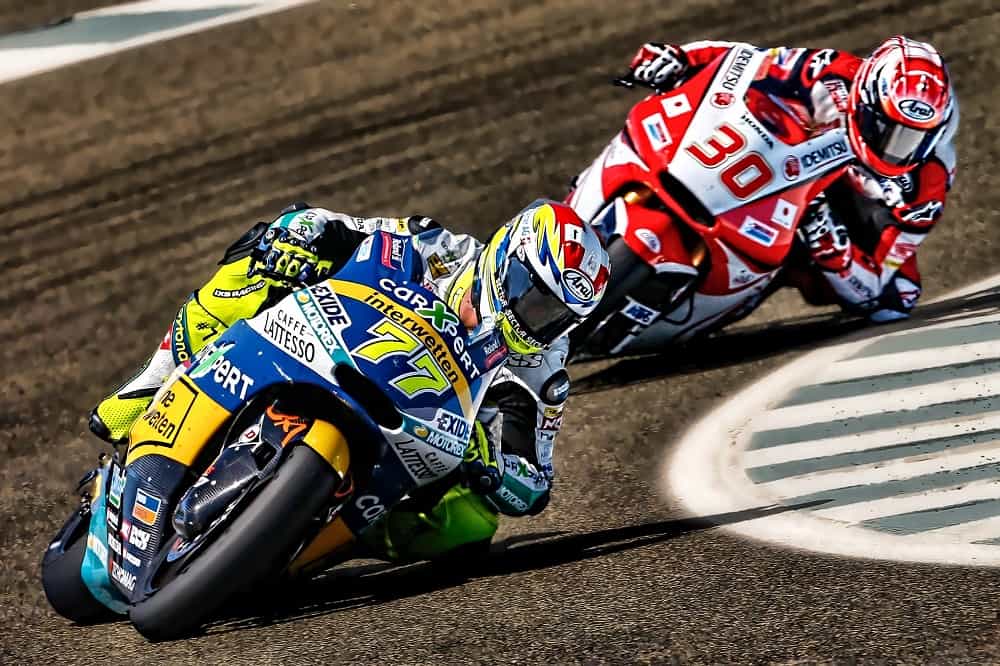
Takaaki Nakagami (30) image courtesy of "driver Photographer" on Flickr
The Japanese rider was 11th quickest in Q1 but, instead of taking up 21st on the grid he dropped to 24th.
Disqualification:
This results in the invalidation of the results obtained in an event, practice, race or ranking.
An immediate disqualification from a practice session or a race may also be pronounced by means of a black flag or a black flag with orange disc.
We saw this happen to Marc Marquez in 2013 following a failure to comply with race direction's tyre change rule at Phillip Island.
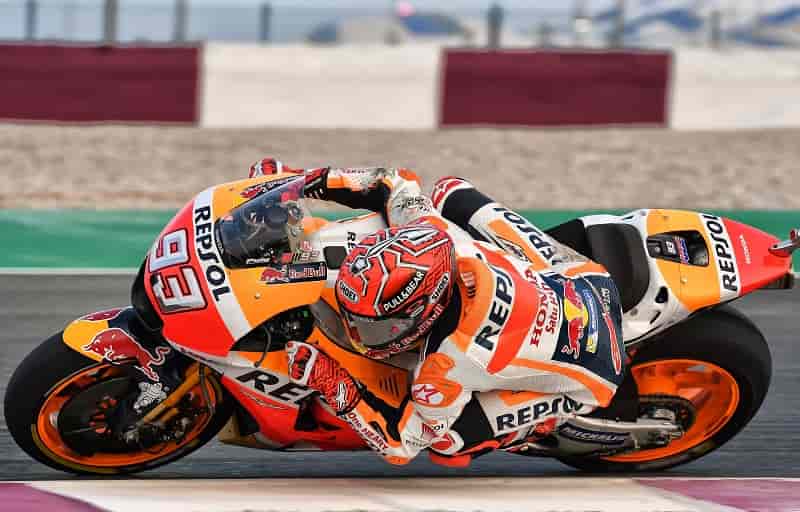
By failing to comply with the order to change tyres part way through the race (by a certain lap it had to be done) he was then racing unsafely and is in direct breach of the rules.
It is also a breach to fail to comply voluntarily with race direction, so they had two grounds to issue the black flag.
While Marquez claimed it was an error and he thought he still had one lap the rider was disqualified, and the decision stood.
He therefore received no points that round.
Tyre Pressures
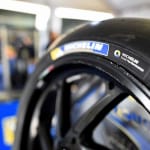
With Michelin facing uncertainty regarding the ability of its tyres to handle the ever-increasing performance demands of MotoGP, and several teams pointing out riders are using tyre pressure to gain advantages, it was decided penalties would now be given when there is a breach.
Breaching the minimum tyre pressure regulations results in a 16-second penalty in the main Grand Prix race and an 8-second penalty in the Sprint races.
Minimum pressures are defined by the regulations (front and rear), and must be respected for a set percentage of laps (60% GP / 30% Sprint).
Failure to do so leads to the penalty.
In 2025 at Qatar, Maverick Vinales finished second in the race but was demoted to 14th having fallen foul of the tyre pressure regulations.
For more on MotoGP tyres and the new rules, see our article tyres for the Uninitiated.
Withdrawal of championship points:
This is the loss of points from the Championship races already run.
This can affect riders or manufacturers, or both together.
An example of this recently happened to Yamaha who were docked 50 constructors' championship points by MotoGP stewards in 2020 after making technical changes to their engine.
A breach of the homologation rules with engines used in the season-opening Spanish Grand Prix.
This did not affect any of the riders’ points.
Suspension:
As stated in the regulations suspension means:
the loss of rights to participate for a specified period of time in any activity under FIM control.
The application of this penalty may also be applied, in the Championship, to one or more practice sessions (or part thereof), or races.
It can be made without a hearing but does have a right to appeal.
At the end of 2022 at Aragon, two Moto3 crew members from Max Biaggi’s Sterilgarda Husqvarna Max team were slapped with a suspension after a bizarre incident where they deliberately made contact with a rival rider trying to exit pit lane during qualifying at the Aragon Grand Prix.
The ban (of the pit crew members) should have covered the Australian Grand Prix at Phillip Island and the Malaysian Grand Prix, and both were fined EUR 2000 (AU$2900).
However Max Biaggi himself was appalled and fired both of them so the suspension was irrelevant in the end.
Exclusion:
Can be the final and complete loss of all rights of participation in any activity under FIM control.
It can apply to any time period FIM determine and can be permanent.
In 2019 we saw test rider Sylvain Guintoli excluded from FP1/FP2 for the Japan MotoGP.

Syl2023, CC BY-SA 4.0, via Wikimedia Commons
He was excluded only from the FP1 and FP2 results for running an engine deemed illegal under homologation rules.
“Suzuki misunderstood the regulation,” team boss Davide Brivio told Motorsport.com. “We thought that, as a wildcard, it was fine for Guintoli to run the new spec engine."
It was not and he was excluded from certain sessions and had to use a different Bike.
So now that we know what some of the penalties are and what they are for, who makes the decisions?
The bodies of the FIM, qualified to deal with race decisions, disciplinary and arbitration matters, are:
These bodies are the ones you will hear most about on race weekend. They make the decisions as the events are happening.
There are also Judges of Fact mentioned in the regulations. Their role is outlined as follows:
Judges of fact are officials in charge of checking certain facts during practices and races and whose observations must be reported immediately for a possible decision.
Statements of fact depend exclusively on a factual observation without any possible adjustment of the sanction which is statutorily and precisely stated.
These statements of facts and the resulting decisions are immediate and in certain cases not subject to protest or appeal, as specified in the relevant regulations
The following bodies are for appeals against decisions made by Race Direction and the stewards panel.
The decisions of the Judge of Fact are usually not granted a right of appeal.
Lodging an appeal
An appeal can be lodged by any individual, rider, team, manufacturer, official etc. affected by a penalty or decision issued by the FIM disciplinary authorities listed above.
But there is a hierarchy as you go through the process as to who can appeal to and for what. It is quite a long section so to make it easier to understand we will stick to the basics.
The FIM Appeal Stewards will hear any appeals against decisions of the FIM MotoGP Stewards Panel.
The FIM Appeal Stewards may confirm or overturn that decision or impose a different penalty.
The FIM Appeal Stewards may refer the case to the MotoGP Court of Appeal if it appears impossible to deal with the case for any valid reason.
Remember no appeal may be lodged against a decision of a judge of fact based on a jump start, a track limit violation or a photo finish among others.
Still not happy?
If the rider is still not happy, they can take the appeal to the MotoGP Court of Appeal
The MotoGP Court of Appeal will hear any appeals against decisions by the FIM Appeal Stewards.
The MotoGP Court of Appeal adjudicates upon request of the FIM MotoGP Stewards Panel, or the FIM Appeal Stewards.
Again, though no appeal may be lodged against a decision of a judge of fact same mentioned above.
Also, no appeal may be lodged if the FIM Appeal Stewards confirm the previous decision of the FIM MotoGP Stewards. In this case, the decision of the FIM Appeal Stewards is final.
If the rider or person is still not happy once they have been heard by the MotoGP Court of Appeal and they still have a matter that is open to appeal, it goes to the Court of Arbitration for Sports (CAS)
Time limits for the lodging of an appeal
The time limit for lodging a statement of appeal is:
The time limits shall be taken from the date and time of receipt of the decision by the person appealing the decision.
This process has received a lot of coverage in the past few weeks following the Marquez Oliveira incident in the opening weeks of the 2025 season.
It highlighted several issues including whether a penalty can be carried until the rider returns from injury whenever that is or if it expires.
This has now been clarified by a ne rule for 2026 that long laps, ride-throughs, and grid-position penalties that aren’t served are cancelled after 365 days.
Anti-doping regulations
MotoGP, like all sports and racing codes, also have drug regulations and anti-doping rules.
It is under this section that Andrea Iannone (29) found himself with a problem in 2019.
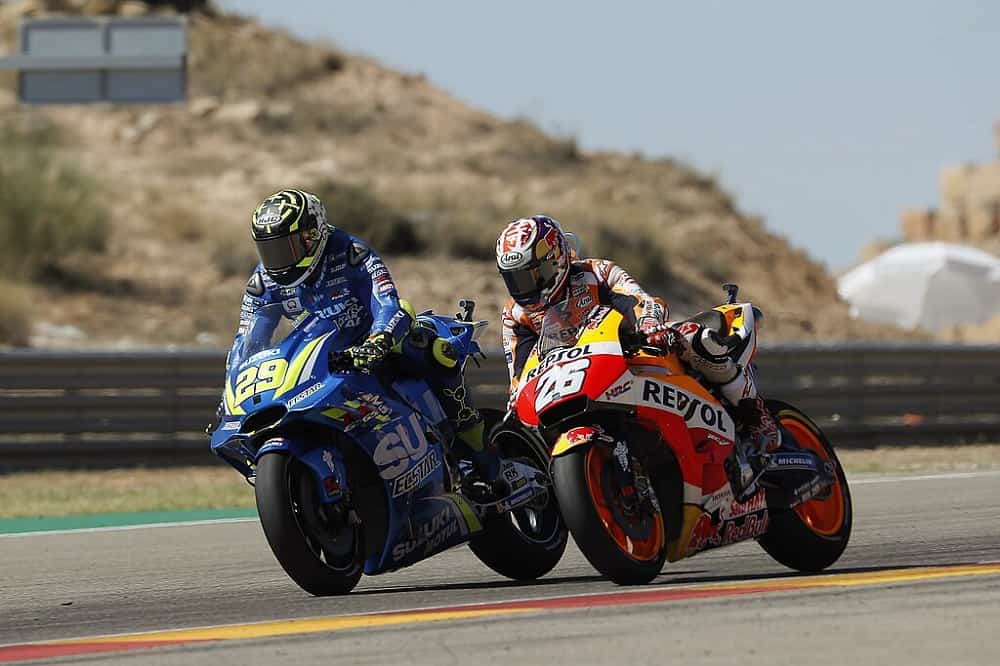
Box Repsol, CC BY 2.0, via Wikimedia Commons
The Italian was banned from competing in any sanctioned motorcycle racing for 18 months after a random drug test taken during the 2019 Malaysian MotoGP.
He returned a positive result for the banned substance drostanolone, an anabolic steroid used in body building (rather counterproductive in the MotoGP world really).
It is believed the drug had been consumed from eating contaminated meat.
However, he was unable to prove this in Court of Arbitration for Sport and his ban was extended to 4 years as requested by WADA (World Anti-Doping Agency).
The ban ended in December 2023 but he did not return to MotoGP.
Instead he rode in World Superbikes for the Ducati satellite team GoEleven (2024 and 2025 seasons)
For 2026 it was planned he would be riding for another Ducati satellite team: Cainam Racing Team.
However, that has not come to fruition and at the time of writing his future riding plans are uncertain.
If you want to read all the regulation ins and outs for yourself, they are available in the FIM official regulation code online (in the document section). In the meantime, hopefully this has cleared up what MotoGP penalties are and what they can be issued for.