Updated 16 February 2026 for the 2026 season
MotoGP Qualifying – The Basics
Each race weekend we wait to hear who has made pole position and often tune in just prior to the race to find out the starting grid.
But how does MotoGP qualifying actually work?
- How are Q1 and Q2 determined?
- How does the sprint race affect things?
- What is the role of Free Practice in bringing us the starting grid?
First, let’s look at what we hear about the most: Q1 and Q2.
This stands for Qualifying 1 (Q1) and Qualifying 2 (Q2), referred to in the rule book as qualifying practice 1 and 2.
Both are 15-minute sessions held on the Saturday morning and they determine the final starting grid.
Qualifying sets the grid for both the Sprint and Sunday’s Grand Prix.
Here is the format:
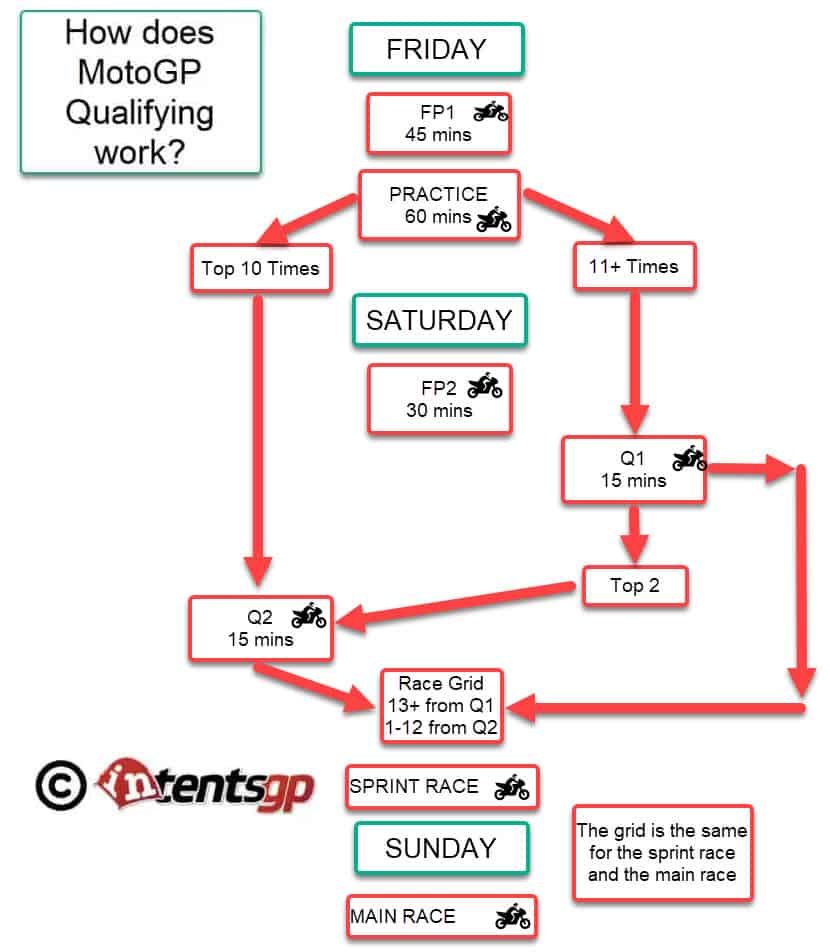
- Fri AM: FP1 (45 mins)
- Fri PM: Practice (60 mins) → top 10 go straight to Q2
- Sat AM: FP2 (30 mins) → then Q1 (15) + Q2 (15)
- Sat PM: Sprint
- Sun AM: Warm-up
- Sun PM: Race
Now let's delve into the detail a little more.
How do we know who will be in Q1 and Q2?
For those new to MotoGP you will notice if you tune in for Qualifying the field of riders is already divided into two groups with positions on the grid.
How does this division of the field occur?
The term timed here does not refer to the duration but rather that the lap times are counting towards qualifying.
The times are used to calculate qualifying as follows: the 10 fastest times recorded across the timed 60 minute Friday Practice session go directly into Q2.
The remaining riders will go into Q1 where if they are placed first or second, they get into Q2 and therefore possibly pole position in both races.
So:
Q1 decides 13th onwards, with the top 2 in Q1 promoted into Q2
Q2 decides positions 1–12
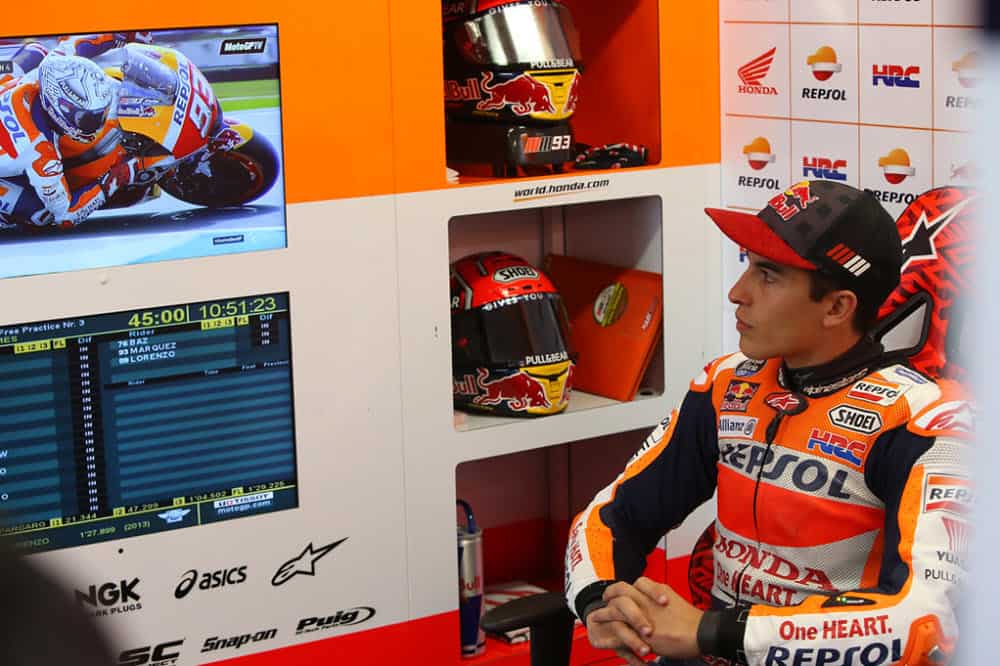
Marc Marquez watching himself in FP. Image courtesy of Box Repsol on Flickr
What is the 105% rule?
What is this you ask?
Math during motor racing!?
It’s a simple calculation I promise – for example if the fastest time is 100 seconds, then all other riders must put up a time of 105 seconds or less to qualify.
To take part in qualifying practice (Q1/Q2), a rider must have achieved 105% of the fastest rider in that session in any one of FP1 / Practice / FP2.
If they fail to make this time they will start, subject to the discretion of the race stewards, from the back of the grid.
For this purpose, the back of the grid means the grid position immediately after the final rider’s qualifying grid position.
If a rider doesn’t set a representative qualifying time (for example due to a crash or mechanical issue), they may have to start from the back of the grid or from a position assigned under the rules.
Race Direction cannot waive the 105% rule other than exceptional force majeure cases for contracted riders.
What if Practice is cancelled?
If Friday afternoon Practice is cancelled, the Saturday morning session will be used to decide who goes to Q2.
If that can’t run, FP1 may be used.
If no sessions run, Race Direction will set the procedure.
How Did The Introduction Of The Sprint races Change Qualifying?
The addition of Sprint races to the weekend for MotoGP class did not change qualifying itself. The same qualifying procedures remained and they decide the grid for both Sprint and the Main Races.
But it did mean a change to pre-qualifying procedures as Dorna did not want to increase track time but rather redistribute it.
To do this they changed the length of Practice sessions and renamed them.
See our flowchart graphic at the bottom of this article for an explanation of the sequence over the race weekend.
It is interesting to note that the rules state grid positions once determined (around 60 minutes after the timed practice for qualifying times and just 10 minutes between Q1 and Q2) are final and not subject to any protest or appeals and will not be revised for any infringements discovered after their determination even if reported to FIM MotoGP Stewards.
While many watching skip right over the Practice session and qualifying figuring it’s the race where all the action is, they are missing some of the most action-packed track time of the weekend.
From Friday afternoon the riders are pushing the limits aiming for Q2 and pole position.
And now with the addition of Sprint Races which offer riders additional points towards the championship, qualifying is even more important as it counts for both grids.
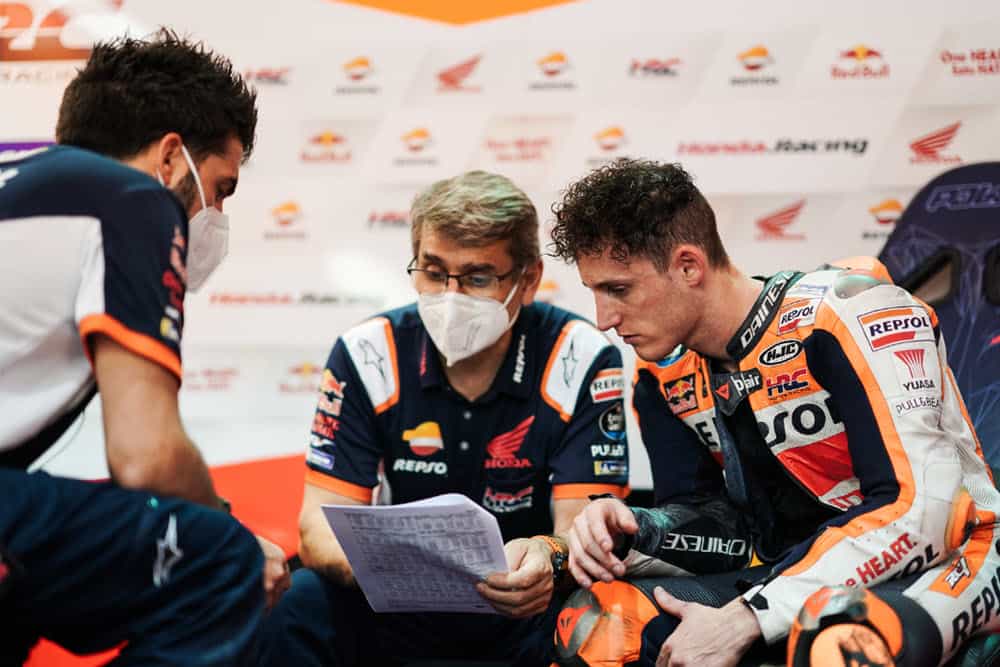
Pol Espargaro studying data after Free Practice at Qatar MotoGP 2022. Image courtesy of Box Repsol on Flickr
However, we can’t underestimate the Q1 riders, many assume this is the back end of the field, the slower riders and that’s simply not the case.
Due to the MotoGP format of collecting up the times from the Practice session to divide the field for Q1 and Q2, no rider is safe from finding themselves in Q1 on the day.
A crash, mechanical issues, physical injury or even a penalty can change the game on race weekend.
We do quite often see big names, factory bikes, and even the championship leaders in Q1 because of poor times in the Practice session.
The golden opportunity to fight for pole again if you top the Q1 leaderboard results in the Q1 session being an action-packed 15 minutes well worth tuning in for.
It’s rare, but the way they have it set out, technically, the slowest rider across the Practice session can still find themselves on pole.
How you ask?
Simple really, during FP sessions if a rider fails to produce a time fast enough for Q1 (top 10 times of the Friday afternoon Practice) then they will find themselves in Q1 – 13th and below, but let’s say the rider had some issues getting the bike set properly for the track in question and by Q1 on Saturday they have this sorted.
Now they are back in their top racing form and are the fastest of Q1 – this means they get to move up to Q2 which decides the 1st to 12th position on the grid.
Now, let’s assume they are the fastest in Q2 and make pole.
Meaning a rider who was out of sorts on Friday can still end up on pole. It’s rare, but the format makes it possible.
If you are not watching the free practice sessions you are really missing out
There is still a need to push on the Friday, especially in the afternoon session to set the best times.
So, if you don’t already have access to the FP sessions and qualifying this fan suggests getting on it, you will not be disappointed especially now you understand how it works and what all the sessions mean in the lead up to qualifying.
Below is a flowchart which we hope will help you better understand the MotoGP qualifying sequence.