(Updated 4 February 2026 regarding the 2026 season and beyond)
For the 2026 season, there have been no major changes to the aerodynamic and winglet rules, and the current framework remains in place.
Aerodynamic parts are still tightly controlled under the FIM’s definition of the “Aero Body” which is explained more fully later in this article.
The other contentious area — aerodynamic upgrades — is also managed through the concessions system. In simple terms, manufacturers in concession ranks A/B/C are allowed one aero update per rider per season, while Rank D manufacturers are allowed two (with conditions on replacing previous specs). More details about concessions are available in our MotoGP testing article.
Looking ahead, a bigger technical reset is planned for 2027 alongside the wider MotoGP regulation changes, so this is the area most likely to see more significant updates in the near future.
Until then, the rules below remain in place.
Aerodynamics in MotoGP has been of growing importance since 2015 when fans first saw purposeful aerodynamic additions to Ducati on the grid.
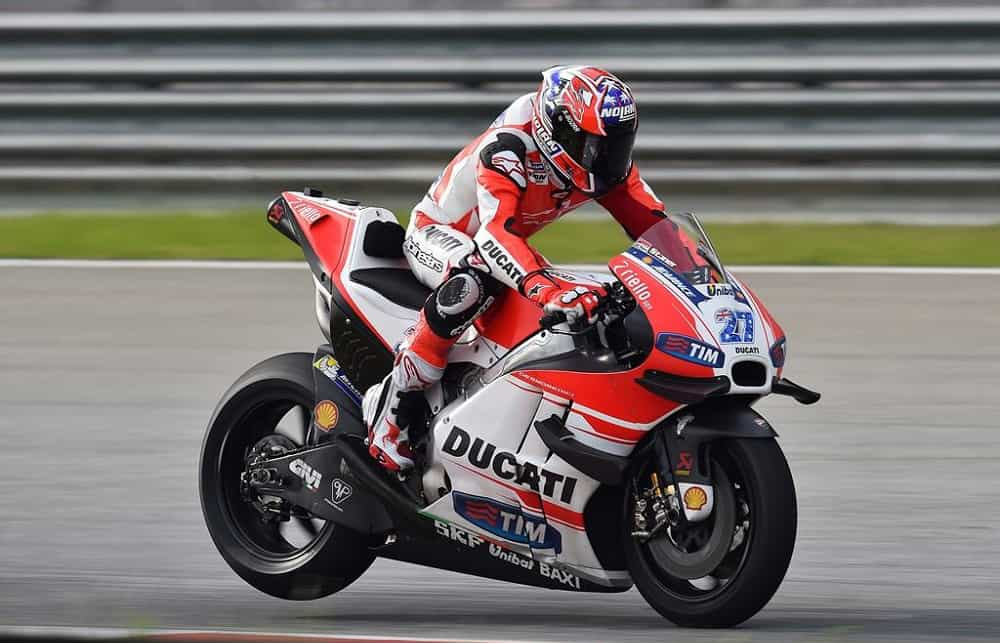
The 2016 Ducati with winglets
Following this arrival of downward force aerodynamics MotoGP banned the use of the 'protruding' style wings or winglets for safety reasons from 2017 onwards.
The original design was too wing like and dangerous in the event of a crash or contact with another rider.
Regulations are worded to allow for fairings and 'integrated wing' attachments to be allowed.
In 2019 the argument was raised again when Ducati began to use the Swingarm mount (aka spoiler/spoon/chin) at Qatar.
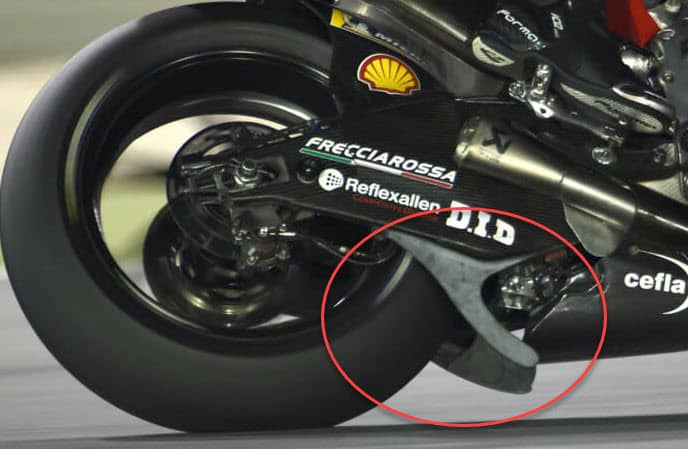
The MotoGP Court of Appeal deemed the swingarm attachment legal and the regulations were again refined to include - any other areas of the bike with 'aerodynamic effect' - now fall under Aero Body rules and must pass the Homologation with the Championship Technical Director prior to the start of the season.
Thereafter it remained stable in the world of aerodynamics until recent times when what is considered an all-out war began with all five factories lining up on the grid in 2023 with F1 style aerodynamics hoping to gain any advantage possible.
It is one of those topics that has created heated debates with some riders and teams vehemently against it and others all for it.
Let’s have a closer look at what aerodynamics are and why it is so contentious in the paddock.
What are Aerodynamics additions?
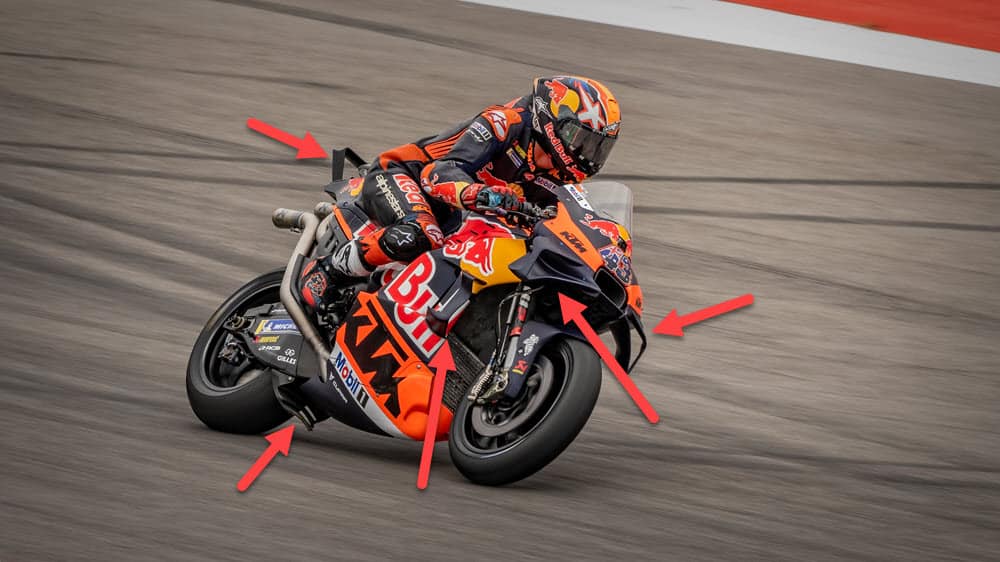
Image courtesy of Joe McGowan on Flickr
We all hear the commentary on this when we tune in but what actually are aerodynamics in MotoGP?
In short, aerodynamics is the study of the resistance force created by the air as it moves over both the bike and rider, it is this resistance that prevents them going faster.
Managing aerodynamics and making additions to change this resistance is not only about faster top speeds on track but also better stability and cooling effects on the bike.
It has been stated by Factory Ducati that aerodynamics may also be able to help with the aerodynamic load on the wheels – this is especially important in regards to the front tyre.
This has a big impact on wheelie control and stability at high speed.
How do aerodynamics help in MotoGP?
On one level aerodynamics may provide the last remaining area teams have to gain some advantage over other teams since all areas of MotoGP are so heavily regulated such as sole tyre provider, number of engines, cylinder diameters, unified Ecu and IMU and so on.
Technically as far as the rider and bike are concerned aerodynamic additions can help with the following:
What are the different types of Aerodynamics?
Wings (winglets)
They create the all-important downforce that allows the bike to maintain contact with the road. Most importantly the front wheel.
The wings seen on the front play a big part in wheelie control and overall safety of the bike.
It also helps divert air in an upward direction rather than horizontal in the case of Ducati, to help create less wake left by the bike.
These also siphon air into particular directions through a series of louvres and other design innovations including under the bike.
This is all designed to take that air through the wings and distribute it to help cool parts such as the engine, brakes, oil and water.
In the case of the spoon/swingarm attachment, some designs channel cooler air toward the rear tyre area, while others help manage heat by directing hot air away.
The amount they can protrude from the bike is limited by regulations.
Spoon or swingarm attachment
This is located under the bike, right in front of the rear wheel.
Initially placed there to help cool the rear wheel by bringing fresh air in between the swingarm and rear wheel but also has the benefit of helping with traction.
Diffuser
Diffusers clean up the air flow making sure it goes where it is needed and that it does so in a stable way.
They also use this to create exit ducts which take flow from the air intake and fire it over the rider’s shoulders to smooth airflow, reducing turbulence and drag.
Creating the right aerodynamic diffuser will actually help with grip when turning.
These ground effect diffusers first used by Ducati are F1 inspired aerodynamics which creates low-pressure area pushing the bike into the track by creating airflow between the fairing and the ground at full lean.
This is called aerodynamic grip as opposed to mechanical grip.
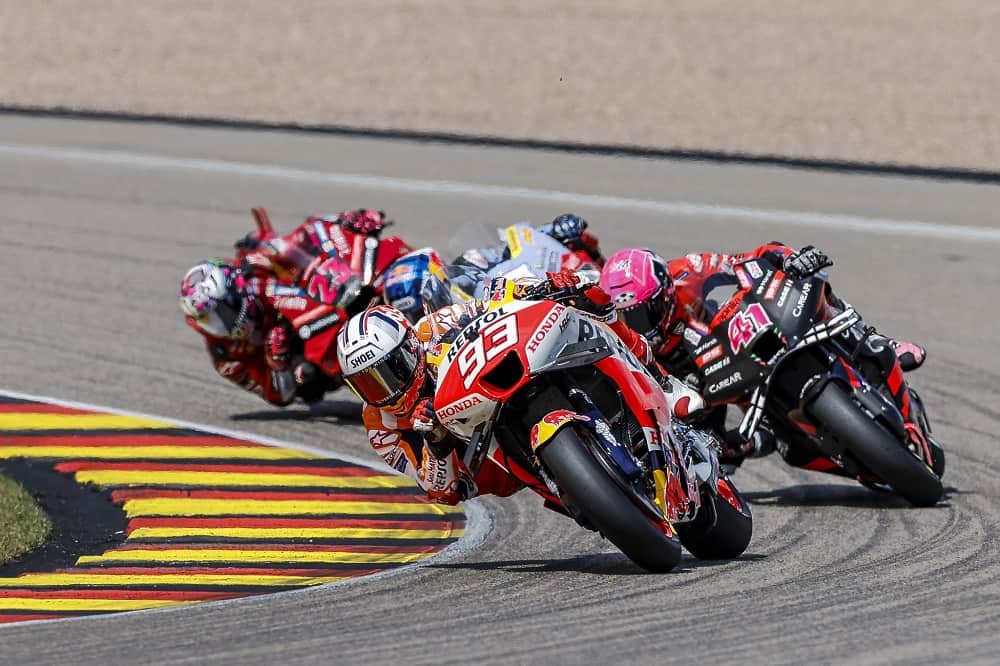
Image courtesy of Box Repsol on Flickr
Are there any disadvantages to aerodynamic additions to the bike?
Straight up the aesthetics are sometimes ruined and the bikes can start to look a little strange up close.
However we must keep in mind these bikes are not built for road users or even sale in any form.
They are purely about racing so the appearance overall is not the most important consideration.
The tight regulations for aerodynamics are in place partly because it is an extremely expensive part of racing, to help alleviate some financial pressure on teams, especially non-factory and newer teams.
There are of course, some technical down sides to playing around with the aerodynamics.
Any stability/downforce gains can be offset by added drag, weight, tyre loading/temperature, or cooling compromises.
What are the Regulations for MotoGP Aerodynamics?
As with most regulations in MotoGP they are not neatly outlined somewhere.
We need to look in a couple of places to understand the rules.
First, we need to understand the term Aero Body. The regulations use this term to refer to aerodynamic additions.
In the regulations the MotoGP Aero Body is defined as:
The portion of the motorcycle bodywork that is directly impacted by the front airflow while the motorcycle is moving forward, and is not in the wake (ie. aerodynamic “shadow”) of the rider’s body or any other motorcycle body parts.
This includes:
The bodywork dimensions are regulated using a reference line: the Aero Body is limited to 600mm maximum width above the reference line and 550mm maximum width below it.
The regulations then go on to outline a whole lot of rules (4 pages!) regarding this within the Bodywork Section (Art. 2.4.4.7).
To simplify matters, the main points to be aware of are as follows:
Only manufacturers in the Concession Ranking D (now just Yamaha) will be able to access two aero updates per rider per season.
However, they must discard one existing aero specification when choosing to utilise the second update. Rankings A, B, and C are allowed only one aero update per rider per season.
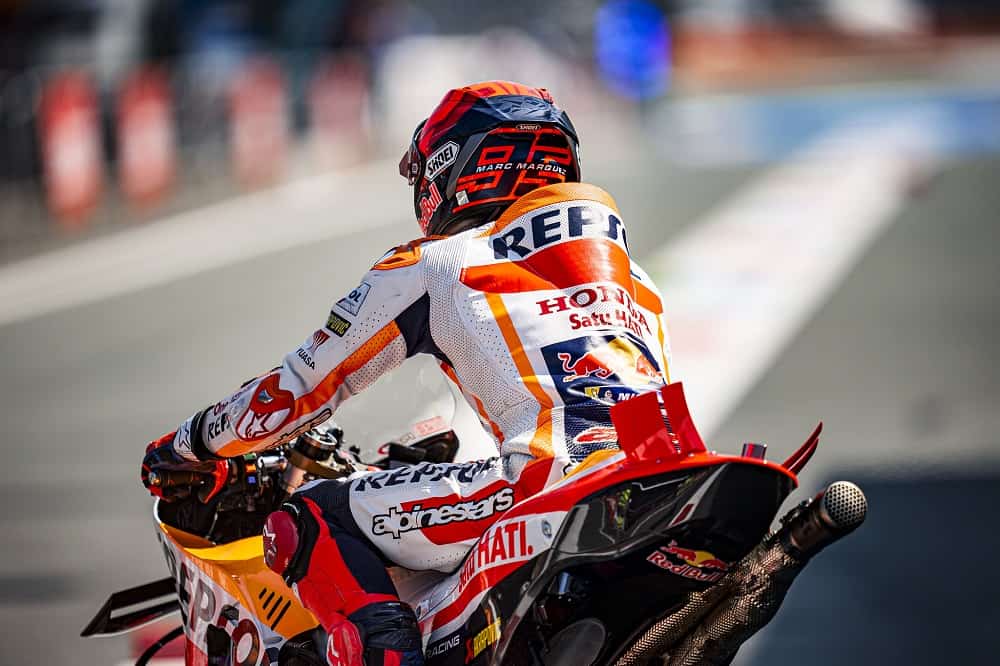
Image courtesy of Box Repsol on Flickr
Taking the rider into consideration
The rider plays a huge part in aerodynamics and teams go to great lengths to study each of their riders through a series of 3D renderings and the use of CFD (computational fluid dynamics).
According to ScienceDirect.com CFD is a science that, with the help of digital computers, produces quantitative predictions of fluid-flow phenomena based on the conservation laws (conservation of mass, momentum, and energy) governing fluid motion.
Which to many of us doesn’t mean too much but when we look at this Ducati factory video showcasing their air flow analysis we can see in this case it means simulating air flow over the rider and bike and making the needed adjustments to the aerodynamics until they are satisfied with the result for each rider.
Aerodynamics in MotoGP have evolved a lot in recent times and exploded over the last couple of seasons.
Regulations are the only way to rein it in as far as some riders and teams are concerned, while others such as factory Ducati continue to push and evolve on this level.
Whether you agree or disagree, it will certainly be interesting to see the future evolution in seasons to come.