Updated 20 February 2026 to reflect new data for the 2026 season.
Every one of the 22 Grands Prix on the 2026 MotoGP calendar carries unique difficulties for the riders and teams.
In 2026 that includes newer/returning venues such as Goiania (Brazil), Balaton Park (Hungary) and Brno (Czechia), each bringing its own demands for braking, grip and temperature management.
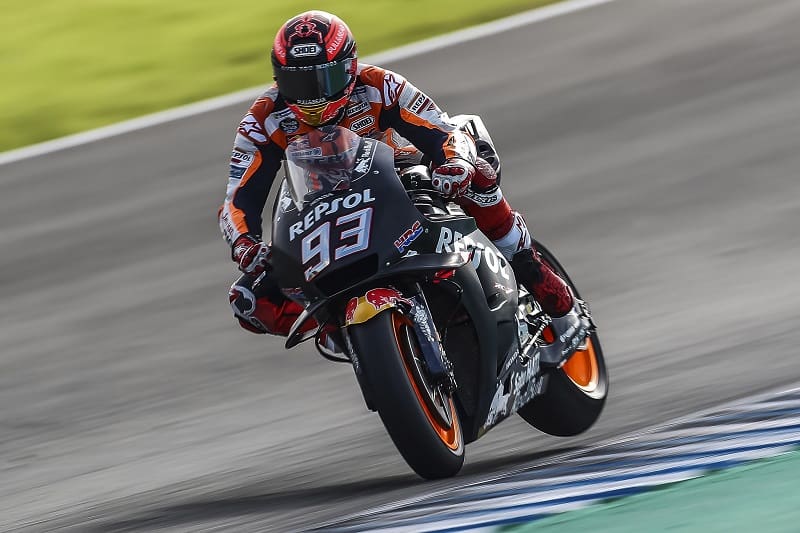
Some have surface issues (COTA, Jerez). Some have erratic weather patterns (the UK and Phillip Island) and others are tough on brakes.
It is said that braking is the most important aspect of racing. No point in going full throttle at 350+ km/h if you can't stop or control it.
It’s not just about being the fastest. You have to be great on the brakes.
So who do MotoGP teams turn to for braking power across a modern MotoGP season—spanning 22 race weekends plus practice, qualifying and Sprint races, with thousands upon thousands of heavy-braking events?
That would be Italian brake manufacturer Brembo.
Brembo has been on the racing scene for over 50 years and proudly supply the entire MotoGP field with their braking system (for more info on the braking system see our MotoGP brakes for beginners article)
We often hear riders and commentators refer to tracks as being the most difficult. It seems they are always claiming the current track is the most demanding and they are; each for differing reasons.
Let’s take a look at a few of the ways Brembo itself categorise the tracks.
Brembo rates each track on a scale of 1 to 6 to determine the overall stress on the brakes for each track. Some might come as a surprise. Here is their latest data:
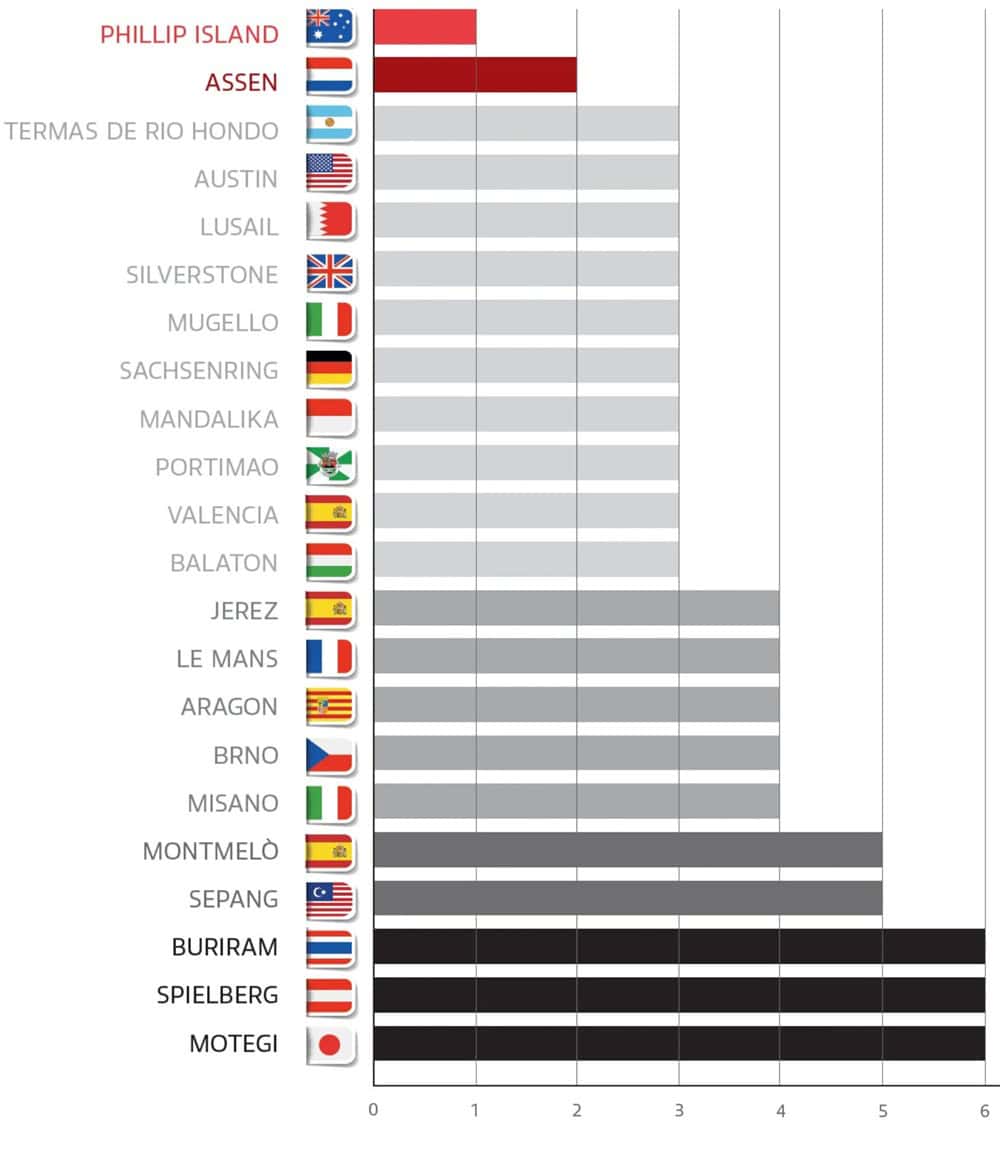
Only three of the 22 circuits listed receive the very hard rating of 6.
So what exactly does Brembo consider when coming up with these ratings?
It’s not just “how often” riders touch the brakes.
Brembo looks at:
For example, Brembo defines “High” braking zones as those typically involving more than 3 seconds on the brakes, lever loads of at least 4 kg, decelerations of 1.4 g or more, and brake pressures above 8 bar.
The amount of times on the brakes sounds like it could give you a good understanding of the stress level on the brakes overall for each track but it is not a very good indicator.
Due to the design of the track and the winding nature of the turns the length of time braking is less, the deceleration is less demanding and the brakes are given time to cool down.
This chart shows the volume of braking across a full Grand Prix race — essentially braking zones per lap × race laps.
That’s useful for understanding how “busy” a circuit is on the brake lever, but it isn’t the same as Brembo’s brake stress / difficulty index, which is driven more by the severity of the hardest stops, how many High/Hard braking zones there are, and how much recovery time the system gets between them.
As a result, some circuits can rack up a high total number of braking actions without being considered especially punishing on brakes.
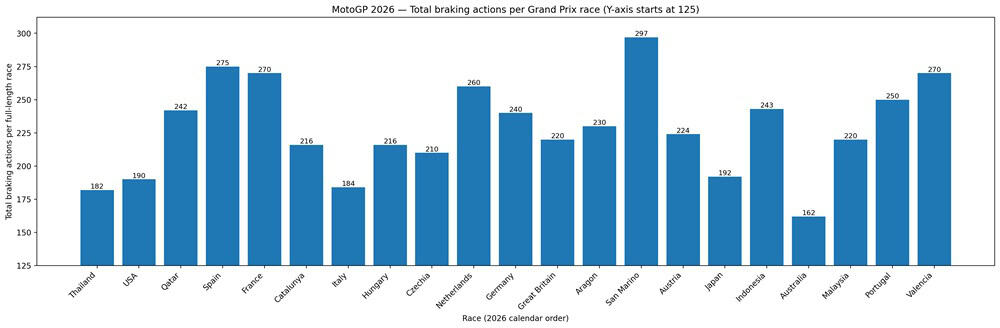
A great example is Assen: it sits high on total braking actions because there are lots of braking zones and a long race distance, but Brembo rates it relatively low on overall brake stress because only a small portion of those zones are truly “Hard”.
Similar “high volume, moderate stress” behaviour appears at circuits like Valencia and Portimão, where the race total can be high but the number of High-category stops is limited — meaning less extreme peak temperatures and less repeated maximum deceleration.
On the flip side, some circuits aren’t the biggest bars on this chart yet sit at the very top of Brembo’s brake-demand rankings.
Spielberg (Austria) and Motegi (Japan) are classic stop-and-go tracks with multiple Hard braking points packed into a lap, so even with fewer total braking actions, the brakes see repeated, high-energy stops with less chance to cool.
Buriram (Thailand) is another example: it isn’t a “highest total actions” track, but Brembo still places it in the maximum stress group because the hardest braking zones are intense and decisive for performance.
On these maximum-stress circuits, riders are restricted to large-diameter finned discs (340 mm or even 355 mm), and smaller 320 mm discs are not permitted.
Temperature plays a big part in the analysis and includes both the track and air temperatures.
Tracks such as Jerez face issues of not only high air temperatures but even higher track temperatures leading to a chance the brakes may overheat.
Add then the heat caused by harsh braking, high deceleration rates and braking sections within close proximity.
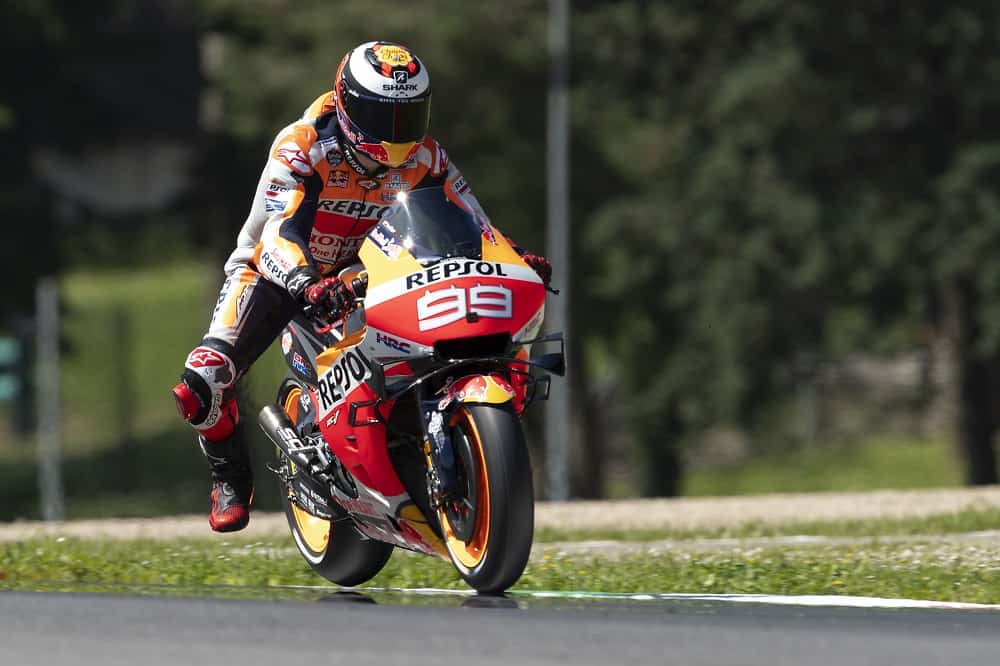
Image courtesy of Box Repsol on Flickr
On the other hand, if it rains or the air temperature is cold, the brakes struggle to maintain their optimal temperature.
IIt’s worth noting that braking tech has evolved, and some riders now run carbon discs even in wet conditions when they can keep them in the operating window.
The amount of cornering is also an important consideration.
Not only the amount but how close they are together and how ‘hard’ the cornering is.
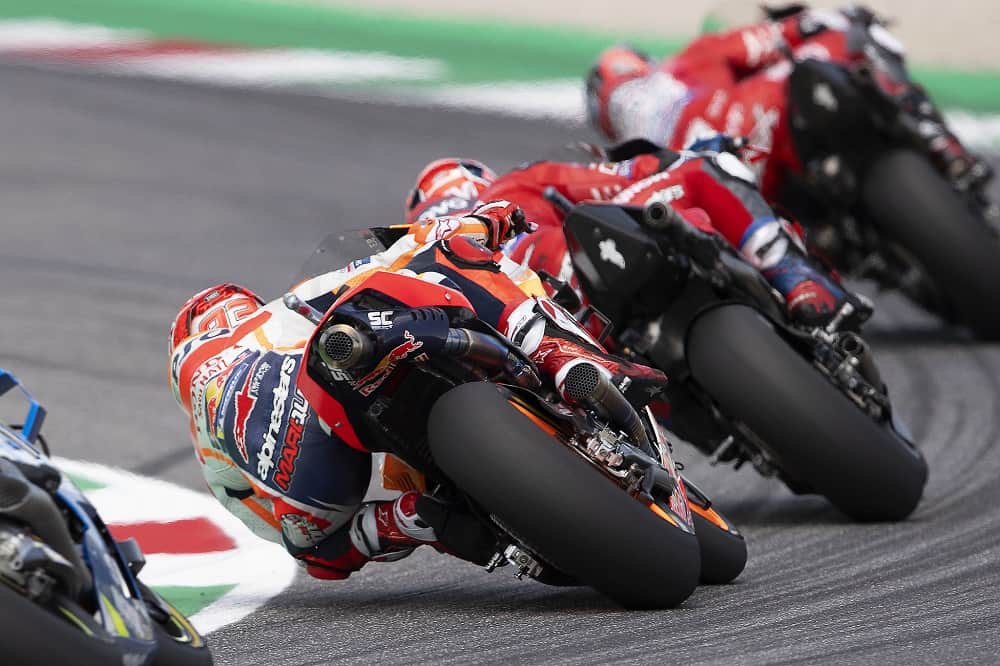
Image courtesy of Box Repsol on Flickr
The cornering can cause temperature issues with the brakes not having time to cool down on tracks with a lot of hard cornering close together.
Add this to the temperature issues to be considered for each location, it is far more complex than first thought and explains to some extent why tracks with less cornering can still be considered harder on the brakes.
Design and Length
While all tracks are approximately the same lap length in terms of kilometres at a quick glance, some tracks are slightly shorter in length requiring an extra few laps to bring the total to about 110 kms per GP round.
For example, Aragon is 5.077 kms per lap and has 23 laps per race, where Sepang is 5.5 kms per lap and has only 20 laps per race.
This has a significant impact on the number of braking instances and therefore affects the amount of stress on the brakes.
Brembo also assesses the deceleration and force experienced by the rider.
The rate at which they must slow down and the space in which they have to do so is quite important to Brembo in deciding how to rate the overall stress on the brakes.
According to a report by Brembo, MotoGP riders regularly experience a force of 1.1g to 1.2g when braking.
1.4g is considered a high average maximum deceleration.
To conclude....
Brembo takes an enormous amount of data (more than we could ever really examine) and turns it into the preferred braking systems for the MotoGP field.
Their investment in continued improvements and technology means our favourite riders are as safe as possible in Brembo's hands.
Data courtesy of Brembo